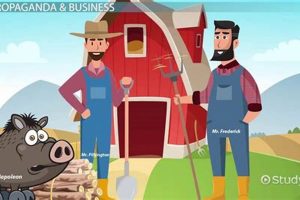
In George Orwell’s allegorical novella Animal Farm, a set of principles, known as the Seven Commandments, form the initial ethical and legal framework for the newly established animal society. These rules, inscribed on the barn wall, are designed to prevent animals from adopting the destructive habits of humans and to ensure equality and freedom. Examples include “Whatever goes upon two legs is an enemy,” “Whatever goes upon four legs, or has wings, is a friend,” and “All animals are equal.” They represent the utopian vision driving the rebellion against Mr. Jones.
The significance of the principles lies in their role as the foundation of Animalism, the animals’ governing ideology. Initially, they provide a sense of unity and purpose, motivating the animals to work together for the common good. Historically, the tenets mirror socialist ideals aimed at eliminating exploitation and creating a classless society. Their existence offers a framework for judging actions and maintaining order, at least in the early stages of the farm’s transformation. The presence of this governing doctrine, at the start of their new society, is therefore critical in creating a common, positive and ethical environment.
The following sections will analyze the specific content of each of these doctrines and their gradual subversion by the pigs, ultimately revealing the corruption and hypocrisy that undermines the revolution’s original goals.
Navigating the Doctrines in Animal Farm
Understanding the complexities of the principles outlined in the allegorical novel Animal Farm requires careful consideration of their implementation and eventual manipulation.
Tip 1: Analyze the original wording of each principle. The initial, straightforward language reflects the animals’ desire for a simple and equitable code of conduct.
Tip 2: Track the changes made to the rules. The gradual alteration of the original text, often subtle at first, reveals the pigs’ insidious rise to power. For example, “No animal shall drink alcohol” becomes “No animal shall drink alcohol to excess.”
Tip 3: Consider the context in which the principles are broken. Examining the specific situations where the rules are violated demonstrates the pigs’ hypocrisy and their ability to justify their actions.
Tip 4: Compare the animals’ initial understanding of the rules with their later interpretations. This highlights the power of propaganda and the manipulation of language in shaping perceptions.
Tip 5: Recognize the parallel between the Commandments and real-world political ideologies. The ideals initially espoused are subverted for the benefit of a ruling class, mirroring historical instances of corrupted revolutions.
Tip 6: Evaluate the animals’ awareness of the manipulation. Note which characters recognize the changing rules and the consequences they face for speaking out.
Tip 7: Understand that the final commandment, “All animals are equal, but some animals are more equal than others,” represents the complete collapse of the original ideals and the establishment of a totalitarian regime.
Effective scrutiny of these guidelines provides a crucial lens through which to interpret the novel’s broader themes of power, corruption, and the dangers of unchecked authority.
The following sections will offer insights into interpreting the allegorical significance of the farm and its inhabitants.
1. Foundation of Animalism
The framework within Animal Farm originates directly from the inscription of the Seven Commandments on the barn wall. These directives represent the core principles of Animalism, the animals’ self-governing philosophy that seeks to overturn human oppression and establish a society of equality and freedom.
- Core Principles of Animalism
The foundational tenets, designed to prevent any return to human-like behavior, dictate fundamental aspects of animal life. Rules such as “Whatever goes upon two legs is an enemy” and “No animal shall sleep in a bed” define the boundary between the old oppressive regime and the envisioned utopian society. These become the cornerstone upon which all subsequent decisions and actions are judged, providing an initial sense of unity and purpose.
- Establishment of Social Order
Beyond simple prohibitions, the Seven Commandments establish a social order among the animals. By defining who is a friend and who is an enemy, the principles lay the groundwork for cooperation and mutual support. This framework promotes a sense of collective identity and shared responsibility, fostering an environment where animals can work together for the common good. The creation of a legal foundation, however rudimentary, signals a break from the arbitrary and exploitative rule of Mr. Jones.
- Ideological Manipulation Potential
Despite their initial promise, the Seven Commandments are inherently vulnerable to manipulation. Their simplicity, intended for easy comprehension by all animals, also makes them susceptible to reinterpretation and distortion. The pigs, possessing superior intelligence and cunning, exploit this vulnerability to gradually alter the rules to suit their own self-serving agendas. This highlights the danger of ideological dogma, even when well-intentioned, when not accompanied by critical thinking and vigilance against power abuses.
- Reflection of Societal Ideals
The establishment and subsequent corruption of the animal’s principles reflect the historical trajectory of various societal and political movements. The initial desire for equality and liberation mirrors socialist ideals, while the eventual rise of a totalitarian regime under the pigs highlights the potential for revolutionary movements to devolve into new forms of oppression. In this context, these tenets serve as a cautionary tale about the importance of safeguarding principles and resisting the concentration of power.
The connection between the foundation of the animal’s dogma and the narrative arc underscores the enduring relevance of Orwell’s allegory. The initial establishment, subsequent alteration, and eventual abandonment of these principles demonstrate how easily even the most idealistic visions can be corrupted by ambition and unchecked authority.
2. Initial Equality Promise
The “Initial Equality Promise” within Animal Farm is intrinsically linked to the inception of the Seven Commandments. These principles, established immediately following the animals’ successful rebellion, embody the aspirational goal of a society free from the inequalities and oppressions experienced under human rule. The Commandments serve as both a declaration of intent and a foundational framework for this new egalitarian order.
- Declaration of Equal Rights
The Commandments, particularly “All animals are equal,” explicitly declare the equal rights and status of all animals on the farm. This foundational principle aims to dismantle the hierarchical structure previously imposed by Mr. Jones, where animals were exploited and treated as subservient beings. The promise of equality provides a rallying point for the animals, fostering a sense of collective identity and shared purpose. This declaration is not merely symbolic; it serves as the basis for all subsequent laws and social norms within the animal community.
- Abolition of Exploitation
Several of the Commandments directly address the abolition of exploitation, a key component of the initial equality promise. Prohibitions against wearing clothes, sleeping in beds, drinking alcohol, and engaging in trade are designed to prevent the adoption of human-like behaviors that lead to inequality and the exploitation of others. These rules aim to create a society where animals are not used for personal gain or treated as mere commodities. They represent a conscious effort to break from the exploitative practices that characterized the old regime.
- Foundation for Collective Governance
The Seven Commandments provide the framework for a system of collective governance, intended to ensure that all animals have a voice in the decisions that affect their lives. By establishing a set of shared principles, the Commandments aim to prevent the concentration of power in the hands of a few. The initial meetings and debates among the animals reflect an attempt to implement this collective governance, with the Commandments serving as the touchstone for resolving disputes and guiding policy decisions. This emphasis on shared governance is a direct response to the autocratic rule of Mr. Jones and a commitment to creating a more democratic and equitable society.
- Vulnerability to Subversion
Despite the noble intentions behind the “Initial Equality Promise” and the Seven Commandments, they are inherently vulnerable to subversion. The simplicity of the Commandments, intended to make them accessible to all animals, also makes them susceptible to manipulation and reinterpretation. The pigs, possessing superior intelligence and a penchant for power, gradually exploit these vulnerabilities to erode the principles of equality and establish their own dominance. This eventual corruption of the initial promise serves as a central theme of the novel, highlighting the challenges of maintaining egalitarian ideals in the face of ambition and unchecked authority.
The “Initial Equality Promise,” as manifested through the Seven Commandments, represents a critical starting point in the animals’ quest for a better society. However, the subsequent distortion and betrayal of these principles underscore the fragility of utopian ideals and the ever-present threat of power corrupting even the noblest intentions.
3. Gradual Subversion Tactics
The erosion of the principles codified as “in animal farm what are the seven commandments” is achieved not through outright rejection, but through a process of gradual subversion. This approach allows the ruling pigs to maintain the appearance of adherence to the foundational rules while systematically undermining their original intent and consolidating their own power.
- Incremental Alteration of Language
A primary tactic involves subtly altering the wording of the original tenets. The change is often so minor as to be initially overlooked by the other animals. For example, the commandment “No animal shall drink alcohol” is modified to “No animal shall drink alcohol to excess.” This seemingly insignificant addition provides a loophole that the pigs exploit to justify their own consumption while ostensibly upholding the rule. This demonstrates how linguistic manipulation can fundamentally change the meaning of established principles.
- Revisionist History and Propaganda
Alongside linguistic alteration, the pigs employ propaganda to rewrite the history of Animal Farm, justifying their actions and demonizing their opponents, particularly Snowball. Through Squealer’s persuasive oratory, the pigs recast events to portray themselves as selfless leaders acting in the best interests of all animals. This manipulation of the past allows them to control the narrative and maintain their authority, even when their actions directly contradict the original ideals embedded “in animal farm what are the seven commandments.”
- Exploitation of Ignorance and Fear
The pigs leverage the limited intelligence and memory of the other animals to their advantage. They exploit the animals’ inability to read and their reliance on the pigs for information. By selectively presenting information and appealing to their fears of Mr. Jones’ return, the pigs effectively control the animals’ perception of reality. This tactic underscores the importance of education and critical thinking in resisting manipulation and upholding fundamental principles.
- Justification Through “Necessary” Exceptions
When blatant violations of the Seven Commandments occur, the pigs justify their actions by claiming that they are necessary for the greater good of Animal Farm. They argue that their superior intelligence and leadership require them to make exceptions to the rules, even if those exceptions benefit them disproportionately. This appeal to expediency allows the pigs to rationalize their behavior and maintain the support of the other animals, who are convinced that their sacrifices are essential for the farm’s survival. This highlights how seemingly pragmatic arguments can be used to undermine ethical principles.
The gradual and insidious nature of these subversion tactics highlights the fragility of ideological foundations. By understanding how these techniques operate, one can better recognize and resist similar attempts to manipulate principles and consolidate power, whether “in animal farm what are the seven commandments” or in real-world contexts.
4. Propaganda's Distorting Effect
The corruption of “in animal farm what are the seven commandments” is inextricably linked to the pervasive use of propaganda by the pigs. Propaganda serves as the primary mechanism by which the original principles are reinterpreted, justified, and ultimately inverted to serve the pigs’ self-interests. The Seven Commandments, initially intended as a bulwark against human exploitation and a foundation for equality, become malleable tools in the hands of the pigs, reshaped by skillful rhetoric and the calculated dissemination of misinformation. Propaganda’s effect is to obscure the truth, manipulate perceptions, and ultimately convince the other animals that the pigs’ actions are aligned with the original revolutionary ideals, even when those actions directly contradict them. For example, Squealer’s eloquent justifications for the pigs’ exclusive consumption of milk and apples initially frames it as a selfless act necessary for their brainwork and, therefore, for the overall well-being of the farm. This effectively redefines equality to mean differentiated contributions and needs.
The influence of propaganda extends beyond mere justification of specific actions. It actively rewrites the past, demonizing Snowball and exaggerating Napoleon’s contributions to the revolution. This revisionist history is crucial for maintaining the pigs’ authority, as it creates a narrative that legitimizes their rule and suppresses dissent. The animals’ inability to verify information independently, coupled with their reliance on Squealer’s persuasive pronouncements, makes them particularly vulnerable to this manipulation. Furthermore, the skillful use of fear, such as the constant threat of Mr. Jones’ return, reinforces the animals’ dependence on the pigs for protection, further solidifying their control. The parallels to real-world instances of totalitarian regimes employing propaganda to maintain power are evident, highlighting the enduring relevance of Orwell’s allegory. The principles, therefore, represent a double-edged sword, easily twisted using manipulative rhetoric.
In summary, the success of the pigs in subverting “in animal farm what are the seven commandments” hinges on their mastery of propaganda. By controlling the flow of information, manipulating language, and exploiting the animals’ fears and vulnerabilities, they are able to distort the meaning of the original principles and establish a totalitarian regime. Understanding the interconnectedness of propaganda and the erosion of foundational principles is crucial for recognizing and resisting similar forms of manipulation in any context. The challenge lies in developing critical thinking skills and fostering independent sources of information to combat the distorting effects of propaganda and safeguard the integrity of core values.
5. Totalitarian Ideology Culmination
The narrative arc of Animal Farm culminates in a fully realized totalitarian regime, a direct consequence of the systematic subversion of “in animal farm what are the seven commandments.” The initial revolutionary ideals, intended to liberate the animals from human oppression, are progressively distorted and replaced by a system of absolute control under the pigs.
- Rewriting the Moral Code
The transformation begins with subtle adjustments to the original Seven Commandments, creating loopholes that allow the pigs to justify their increasingly self-serving actions. This process reaches its apex with the complete rewriting of the foundational principle, “All animals are equal,” to “All animals are equal, but some animals are more equal than others.” This final alteration signifies the complete abandonment of the revolution’s initial promise and the formal codification of a hierarchical system where the pigs are elevated above all other animals. Such manipulation of fundamental principles is a hallmark of totalitarian regimes, as seen in the distorted interpretations of socialist ideology in Stalinist Russia.
- Monopoly on Information and Propaganda
Totalitarian control is maintained through the pigs’ absolute control over information and the dissemination of propaganda. Squealer, the pigs’ chief propagandist, skillfully manipulates language and revises history to justify the pigs’ actions and suppress dissent. The other animals are kept in a state of ignorance and fear, unable to question the pigs’ authority or challenge their version of events. This mirrors historical instances of state-controlled media and censorship, where access to information is tightly regulated to maintain political control and suppress opposition voices, such as in Nazi Germany.
- Suppression of Dissent and Use of Force
As the pigs’ power consolidates, dissent is met with increasingly harsh repression. Napoleon’s dogs, originally intended as guard animals, are transformed into a private police force used to intimidate and silence any opposition. Public executions and purges become commonplace, instilling fear and obedience among the animals. This systematic use of force to suppress dissent is a characteristic feature of totalitarian regimes, as demonstrated by the violent crackdowns on political opponents in various authoritarian states throughout history, like in Maoist China.
- Cult of Personality and Deification of the Leader
Napoleon cultivates a cult of personality, portraying himself as the benevolent and all-knowing leader of Animal Farm. He is given grandiose titles and depicted in heroic imagery, fostering a sense of unquestioning loyalty and devotion among the animals. This deliberate creation of a cult of personality is a common tactic employed by totalitarian leaders to consolidate their power and suppress any potential challenges to their authority. Examples include the deification of Kim Il-sung in North Korea, where the leader is elevated to a near-mythical status.
The culmination of these facets represents the complete inversion of the initial revolutionary ideals expressed “in animal farm what are the seven commandments.” What began as a movement for equality and liberation devolves into a system of oppression and exploitation, mirroring the historical trajectory of various revolutions that have succumbed to totalitarian rule. The distortion and ultimate abandonment of the original principles serve as a cautionary tale about the dangers of unchecked power and the importance of vigilance in safeguarding fundamental values.
Frequently Asked Questions
This section addresses common inquiries regarding the Seven Commandments within George Orwell’s Animal Farm, providing clarifying information on their significance and role in the narrative.
Question 1: What is the origin of the principles within Animal Farm?
The principles originate from Old Major’s speech, where he outlines the evils of human oppression and envisions a society where animals live in equality and freedom. These tenets are subsequently formalized into the Seven Commandments and inscribed on the barn wall.
Question 2: Why were the rules simplified in the first place?
Simplification was deemed necessary to ensure comprehension by all animals, regardless of their intelligence level. The goal was to create a universally accessible ethical code that could be easily understood and followed, fostering unity and preventing the adoption of human vices.
Question 3: Who was responsible for altering these doctrines?
The pigs, particularly Squealer, were responsible for gradually altering the Commandments to justify their actions and consolidate their power. Squealer’s persuasive rhetoric and manipulation of language played a key role in convincing the other animals that these changes were necessary for the good of the farm.
Question 4: What are some examples of manipulating the rules?
Examples include changing “No animal shall sleep in a bed” to “No animal shall sleep in a bed with sheets,” allowing the pigs to sleep in beds while technically adhering to the original wording. Another instance is altering “No animal shall drink alcohol” to “No animal shall drink alcohol to excess,” enabling the pigs to consume alcohol while maintaining the appearance of following the rules.
Question 5: Is there symbolic meaning to the number Seven?
The symbolic significance of the number seven is open to interpretation. It can be seen as representing a complete or perfect set of principles. Alternatively, it might reflect the limited intellectual capacity of the animals, who are unable to conceive of a more complex ethical code.
Question 6: What is the ultimate fate of the original rules?
The Seven Commandments are eventually replaced by a single maxim: “All animals are equal, but some animals are more equal than others.” This signifies the complete abandonment of the revolution’s initial ideals and the establishment of a totalitarian regime where the pigs are elevated above all other animals.
The manipulation and ultimate abandonment of the basic principles underscore the novel’s central themes of power, corruption, and the dangers of unchecked authority.
The following section will present a detailed analysis of key characters and their allegorical representations.
The Undermining of Foundational Principles
This exploration of “in animal farm what are the seven commandments” reveals the progressive corruption of revolutionary ideals. Initially intended to ensure equality and prevent exploitation, these principles are systematically manipulated, reinterpreted, and ultimately replaced by a single, stark statement of inequality. The pigs control over language, historical revisionism, and suppression of dissent are critical elements in this process.
The fate of these initial doctrines serves as a stark warning about the fragility of utopian visions and the ever-present threat of power consolidating into oppressive structures. Scrutiny of founding principles, vigilance against manipulative rhetoric, and the preservation of critical thought are essential safeguards against the perversion of even the noblest ideals, both within fictional narratives and in the broader human experience.