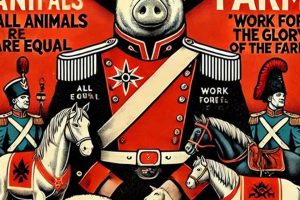
The initial chapter of George Orwell’s Animal Farm introduces Manor Farm and its discontented animals. Old Major, a prize-winning boar, gathers the animals to share a dream of a world free from human oppression. He delivers a rousing speech outlining the injustices they suffer under Mr. Jones’s rule and teaches them the revolutionary song, “Beasts of England.” This meeting plants the seeds of rebellion in their minds.
The significance of the opening lies in establishing the core themes of the novella: oppression, revolution, and the desire for a better society. It provides the historical and social context, mirroring the pre-revolutionary conditions in Russia. The speech of Old Major is particularly important because it identifies the enemy (humans) and provides a utopian vision that motivates the animals to consider radical change. The “Beasts of England” becomes the anthem of their aspirations and unity.
The chapter serves as the foundation for understanding the events that follow. It sets the stage for the animals’ eventual uprising and their attempts to create an egalitarian community, exploring the inherent challenges and potential pitfalls of revolutionary movements.
Analyzing the Opening of Animal Farm
Effective understanding of George Orwell’s Animal Farm necessitates a thorough analysis of its initial chapter. This analysis can be approached with specific strategies to extract maximum meaning.
Tip 1: Identify the Key Players: Note the significance of Old Major and his role as the instigator of revolutionary thought. Consider the characteristics of other animals mentioned, foreshadowing their future roles.
Tip 2: Analyze Old Major’s Speech: Deconstruct the rhetoric employed by Old Major. Identify the persuasive techniques used to galvanize the animals and the specific grievances highlighted against human exploitation.
Tip 3: Understand the Symbolism: Recognize the allegorical nature of Manor Farm and Mr. Jones. Consider them as representing the Tsarist regime in Russia, establishing the historical context for the narrative.
Tip 4: Examine the Role of “Beasts of England”: Investigate the song’s purpose as a revolutionary anthem. Determine its ability to unify the animals under a common goal and its potential for propaganda.
Tip 5: Note the Elements of Foreshadowing: Pay close attention to subtle hints and predictions within the chapter. These hints can indicate future conflicts, power dynamics, and the eventual corruption of the animals’ ideals.
Tip 6: Consider the Narrative Structure: Observe how Orwell establishes the setting, introduces the characters, and sets the thematic stage for the rest of the novella. The chapter’s structure provides a blueprint for understanding the narrative’s progression.
Tip 7: Research the Historical Context: Develop a familiarity with the Russian Revolution. Understanding the historical events that inspired Animal Farm provides a deeper appreciation for the chapter’s allegorical meaning.
By following these analytical steps, a more comprehensive understanding of the opening of Orwell’s Animal Farm can be achieved, allowing for a deeper appreciation of the novella’s allegorical and thematic complexities.
Effective comprehension of the first chapter provides a crucial foundation for interpreting the subsequent narrative developments and recognizing the broader social and political commentary embedded within the work.
1. Old Major's Speech
Old Major’s Speech constitutes the cornerstone of the initial chapter’s narrative. It is not merely an element within the “summary of chapter 1 in animal farm,” but the catalyst that ignites the plot’s central conflict. The speech directly causes the animals’ discontent, acting as the primary driver for their subsequent actions. By articulating the grievances stemming from human exploitation, Old Major establishes the ideological foundation for the rebellion. Without this speech, the chapter would lack its critical momentum, and the animals’ motivation for revolution would be absent.
Consider, for example, historical parallels such as speeches by revolutionary figures like Vladimir Lenin or Martin Luther King Jr. These speeches, akin to Old Major’s, articulated injustices and spurred action. The practical significance of understanding this connection lies in recognizing the power of rhetoric to incite social change and highlight systemic issues. Analyzing Old Major’s speech enables a critical examination of persuasive language and its impact on shaping collective action. It demonstrates how a single, well-delivered message can alter the course of events, prompting reflection on the effectiveness and manipulation of words.
In conclusion, Old Major’s speech is inextricably linked to the chapter’s summary. It serves as both a cause and a crucial component, driving the narrative forward. Recognizing this connection provides vital insights into the dynamics of revolution, the role of leadership, and the enduring power of language. Challenges in interpreting the speech may arise from subjective assessments of its merits, but a thorough analysis of its rhetorical devices and historical context provides a solid basis for comprehending its significance to the entire narrative.
2. Animal Discontent
Within the “summary of chapter 1 in animal farm,” animal discontent functions as a fundamental element and a direct consequence of their living conditions under Mr. Jones. This discontent stems from the animals’ perceived exploitation and mistreatment. Their resentment is not merely a background detail; it is a driving force behind their receptiveness to Old Major’s revolutionary ideas. The “summary of chapter 1 in animal farm” is incomplete without acknowledging how the daily injustices endured by the animals create the fertile ground for rebellion. The animals’ dissatisfaction is palpable throughout the chapter, manifested in their eagerness to listen to Old Major and their enthusiastic participation in singing “Beasts of England.”
The significance of this connection is underscored by real-world parallels. Historically, social unrest often arises from widespread dissatisfaction among a populace. For example, the French Revolution was fueled by the Third Estate’s discontent with the aristocratic privileges and economic hardships. Similarly, the animals’ feelings of being overworked, underfed, and ultimately disposable contribute significantly to their desire for a radical change in their social order. This chapter acts as a lens through which we can examine the common factors that lead to revolutionary movements: a shared sense of grievance, a belief in the possibility of a better future, and a willingness to challenge the existing power structure. Comprehending this dynamic enables a deeper appreciation of the allegorical function of Animal Farm, connecting the fictional narrative to broader historical and social realities.
In conclusion, the presence of animal discontent is an integral component of the chapter summary. It serves as the catalyst for the subsequent events, showcasing the interplay between oppression, disillusionment, and revolutionary potential. While interpretation of the precise level of discontent may vary, its undeniable presence and pivotal role in shaping the narrative trajectory cannot be overlooked. The chapter effectively demonstrates how widespread dissatisfaction can lay the foundation for social upheaval and the pursuit of a different socio-political order. The animal discontent in chapter 1 is not only a plot device but also a stark reflection of historical and contemporary social dynamics, making its understanding essential for interpreting the narrative’s deeper meaning.
3. Human Oppression
Human oppression forms the central conflict and driving force within the first chapter of Animal Farm. The animals’ perception and experience of this oppression under Mr. Jones are not mere background details, but rather the core motivation for their revolutionary aspirations. This oppression provides the thematic foundation upon which the entire narrative is built.
- Exploitation of Labor
The animals in Chapter 1 are subjected to constant labor with minimal reward. They produce goods and services that benefit Mr. Jones, receiving only enough sustenance to survive and continue working. This is a clear parallel to historical systems of forced labor and exploitation. An example from reality is the serfdom system in Russia, where peasants were bound to the land and forced to work for landowners with little to no compensation. The animals’ oppression in Animal Farm functions similarly, prompting a desire for a more equitable distribution of resources and control over their own labor.
- Denial of Autonomy
The animals are deprived of any decision-making power concerning their own lives. They are subjected to the will of Mr. Jones, who dictates their activities, rations, and ultimate fates. This lack of autonomy mirrors authoritarian regimes where individuals are denied basic freedoms and self-determination. The absence of self-governance directly contributes to the animals’ discontent and fosters a longing for a society where they can control their own destiny.
- Physical and Emotional Abuse
While not explicitly detailed, the underlying implication of physical abuse and the obvious lack of emotional care contribute to the animals’ plight. The general atmosphere of neglect and the threat of the whip represent a form of oppression. Historical instances of physical abuse within oppressive regimes, such as the use of torture and intimidation, highlight the severity of this form of control. The animals’ fear and submissive behavior demonstrate the psychological impact of this oppression, fueling their desire for freedom from such mistreatment.
- Deprivation of Resources
The animals are denied access to the fruits of their own labor, receiving only the bare minimum to survive. The disproportionate distribution of resources, with Mr. Jones enjoying a life of relative comfort while the animals struggle, represents a fundamental injustice. This echoes historical cases of economic inequality where a small elite class controls the majority of wealth, leaving the working class impoverished. The animals’ deprivation fosters a sense of resentment and reinforces the belief that they are being exploited for the benefit of others.
These facets of human oppression, as depicted in the initial chapter, are integral to the overall narrative. They provide the context for the animals’ rebellion, underscore the themes of social injustice and inequality, and establish the allegorical connection to historical instances of oppression. The chapter serves as a powerful indictment of systems that exploit and dehumanize individuals, highlighting the importance of autonomy, fair labor practices, and equitable distribution of resources.
4. Revolution's Seed
Within the “summary of chapter 1 in animal farm,” the concept of ‘revolution’s seed’ denotes the initial planting of revolutionary ideals within the animal community. This is directly attributable to Old Major’s speech, which serves as the primary catalyst. The speech does not merely outline grievances; it introduces a framework for understanding their oppression and offers a tangible vision of liberation. Consequently, the animals, initially passive recipients of Mr. Jones’s dominion, begin to contemplate the possibility of an alternative social order. Therefore, the ‘revolution’s seed’ is not simply a plot point; it represents the crucial transition from docile acceptance to nascent resistance. It is vital to the summary because it lays the groundwork for all subsequent events, including the eventual uprising and the animals’ attempts at self-governance.
Consider, for example, the impact of Enlightenment philosophers on the French Revolution. Thinkers such as Rousseau and Voltaire articulated ideas of liberty, equality, and popular sovereignty, which spread among the French populace and fueled revolutionary fervor. Similarly, Old Major’s speech disseminates the concepts of animal equality and freedom from human tyranny, which resonates with the animals’ existing dissatisfaction. This connection highlights the critical role that ideology plays in sparking revolutionary movements. The practical significance of understanding this dynamic lies in the ability to analyze and interpret the ideological origins of social and political upheavals. Furthermore, recognizing the power of ideas to incite change allows for a more nuanced understanding of historical events and contemporary social movements.
In conclusion, the ‘revolution’s seed,’ as manifested in Chapter 1 of Animal Farm, is inextricably linked to the broader narrative arc. It is a direct consequence of the animals’ pre-existing discontent and Old Major’s ideological influence. This seed is crucial to understanding the ensuing rebellion. While interpreting the long-term consequences of this revolutionary seed presents challenges, recognizing its origins and initial impact is essential for grasping the complexities of Orwell’s allegorical narrative. The chapters summary hinges on this initiation of revolutionary thought. The ‘revolution’s seed’ metaphor is fundamental to unraveling the story’s themes of oppression, power, and the potential for both liberation and tyranny.
5. "Beasts of England"
“Beasts of England,” the song introduced in the initial chapter of Animal Farm, serves as a powerful symbolic and narrative device, inextricably linked to the chapter’s essence. It represents the concretization of the animals’ revolutionary aspirations, transforming abstract discontent into a unified, emotionally charged expression of hope and rebellion.
- Unifying Force
The song provides a common identity and purpose for the animals. Prior to its introduction, their discontent exists in a fragmented state. “Beasts of England” unifies them under a shared vision of freedom, creating a collective consciousness that transcends individual differences. In analogous historical contexts, national anthems have served a similar purpose, fostering a sense of shared identity and patriotism within a population. The song, therefore, facilitates the transition from individual dissatisfaction to collective action.
- Expression of Revolutionary Ideals
The lyrics of “Beasts of England” encapsulate the core tenets of the animals’ nascent ideology: liberation from human oppression, the promise of a better future, and the rejection of existing social hierarchies. The song functions as a manifesto, distilling complex political ideas into a readily accessible and emotionally resonant form. Revolutionary songs like “La Marseillaise” in France and “The Internationale” for socialist movements have similarly served as vehicles for spreading revolutionary ideologies and mobilizing support.
- Propaganda Tool
The song is inherently a form of propaganda, promoting the animals’ cause and demonizing humans. Its repetitive melody and simple lyrics are designed to be easily memorized and disseminated, effectively indoctrinating the animals with revolutionary fervor. Similar techniques have been employed throughout history by various political movements to sway public opinion and galvanize support for their cause. The ease with which “Beasts of England” is adopted and sung by the animals highlights its effectiveness as a tool for ideological indoctrination.
- Foreshadowing of Corruption
While initially representing noble aspirations, the eventual corruption and manipulation of “Beasts of England” foreshadow the degeneration of the revolution itself. The song’s eventual replacement by a less inspiring anthem reflects the erosion of the animals’ original ideals and the consolidation of power by the pigs. This mirrors historical instances where revolutionary slogans and symbols have been distorted and appropriated by authoritarian regimes to maintain control.
In conclusion, “Beasts of England” is not merely a song; it is a microcosm of the revolution itself. Its initial unifying power, ideological content, and eventual corruption provide a crucial lens through which to understand the complexities and ultimately tragic trajectory of the animals’ rebellion, making it a pivotal element of the chapter’s central themes.
6. Manor Farm Setting
The Manor Farm setting is not merely a backdrop in the initial chapter; it constitutes an integral element influencing the narrative’s development and thematic exploration. It is through the depiction of Manor Farm that the reader gains an understanding of the animals’ pre-revolutionary existence, which consequently shapes their motivations and actions. The setting itself becomes a symbol of oppression and exploitation, directly fueling the animals’ desire for change as articulated by Old Major. This connection is causal: the conditions prevalent at Manor Farm precipitate the events described in the chapter’s summary.
The significance of Manor Farm as a component of the summary lies in its function as a microcosm of societal structures. The hierarchical arrangement, with Mr. Jones as the ruling entity and the animals relegated to subordinate roles, mirrors real-world social inequalities. The farm’s physical environment, characterized by limited resources and demanding labor, reinforces the animals’ sense of deprivation and injustice. For example, feudal societies, with their land-owning aristocracy and peasant workforce, provide a historical parallel to the Manor Farm setting. Understanding this allegorical connection allows for a deeper appreciation of the chapter’s commentary on power dynamics and social stratification. The practical application of this understanding extends to analyzing other literary works and historical events through the lens of social critique. It allows readers to more accurately identify the symptoms of societal inequality and evaluate potential solutions.
In conclusion, the Manor Farm setting is inextricably linked to the summary of the chapter, serving as both a catalyst for the animals’ rebellion and a symbolic representation of broader societal issues. The chapter summary is incomplete without an appreciation for how the setting shapes the events and themes presented. Challenges in interpreting the setting may arise from a superficial reading that overlooks its symbolic significance, however, a comprehensive understanding of its role is critical to unlocking the chapter’s full meaning within the allegorical framework of Animal Farm.
7. Allegorical Foundation
The initial chapter’s allegorical foundation profoundly shapes its narrative content. The “summary of chapter 1 in animal farm” cannot be fully grasped without acknowledging the chapter’s deliberate mirroring of events leading up to the Russian Revolution. Old Major’s speech, for instance, directly parallels the Marxist ideology disseminated by figures like Vladimir Lenin, thereby positioning Manor Farm as a representation of Tsarist Russia ripe for revolution. The animals’ discontent under Mr. Jones’s rule reflects the widespread poverty and oppression suffered by the Russian peasantry, setting the stage for a rebellion driven by a yearning for social and economic equality. The practical significance of understanding this allegorical link lies in its ability to unlock deeper levels of meaning within the novella, transforming a simple farmyard tale into a powerful critique of totalitarianism and the corruption of revolutionary ideals. An accurate “summary of chapter 1 in animal farm” must therefore underscore these real-world connections.
The allegorical foundation extends beyond mere surface-level parallels. The relationships between characters are also imbued with symbolic weight. Mr. Jones represents the incompetent and self-serving Tsar Nicholas II, while the various animals embody different segments of Russian society with their own particular roles and aspirations. For example, the hardworking Boxer symbolizes the loyal but ultimately exploited working class, and the cynical Benjamin represents the skeptical intellectuals who foresee the revolution’s inevitable downfall. Recognizing these allegorical connections allows for a more nuanced understanding of the political and social dynamics at play within the story. Understanding these dynamics also allows one to view the story as more than just animal characters: it is a lesson to be learned. It showcases the dangers of political unrest. Without a consideration of the allegorical foundation, the ‘summary of chapter 1 in animal farm’ remains incomplete, lacking the critical depth that transforms it into a meaningful social and political commentary.
In summary, an accurate “summary of chapter 1 in animal farm” relies heavily on recognizing its allegorical foundation, specifically its connection to the Russian Revolution and the societal forces that fueled it. Challenges in interpreting the allegory may arise from a lack of familiarity with Russian history. However, by acknowledging these real-world connections and symbolic relationships, the initial chapter transcends a basic plot summary and offers profound insights into the dangers of unchecked power, the fragility of revolutionary ideals, and the enduring human capacity for both hope and betrayal. It is a critical part of the full analysis of the summary.
Frequently Asked Questions
The following questions address common inquiries regarding the significance and interpretation of the first chapter of George Orwell’s Animal Farm.
Question 1: What is the primary purpose of Chapter 1 in the context of the entire novella?
The initial chapter establishes the foundational elements necessary for understanding the subsequent narrative. It introduces the characters, the setting, and the central conflict, laying the groundwork for the animals’ rebellion and the exploration of themes such as oppression, revolution, and social inequality.
Question 2: Why is Old Major’s speech so crucial to the chapter’s overall message?
Old Major’s speech serves as the catalyst for the animals’ revolutionary aspirations. It identifies the source of their oppression (humans), articulates a vision of a better future, and provides the ideological justification for their rebellion. The speech plants the seeds of dissent and motivates the animals to consider radical change.
Question 3: What does “Beasts of England” symbolize within the chapter’s narrative?
“Beasts of England” functions as a unifying anthem for the animals, expressing their shared desire for freedom and equality. It embodies the ideals of the revolution and serves as a powerful propaganda tool, galvanizing the animals and solidifying their collective identity.
Question 4: How does the setting of Manor Farm contribute to the chapter’s overall meaning?
Manor Farm represents a microcosm of societal structures, with Mr. Jones embodying the ruling class and the animals representing the exploited working class. The farm’s oppressive conditions and unequal distribution of resources highlight the injustices that fuel the animals’ rebellion, thereby emphasizing the need for change.
Question 5: In what ways does Chapter 1 establish the allegorical nature of Animal Farm?
The chapter mirrors the events leading up to the Russian Revolution, with Mr. Jones representing Tsar Nicholas II and the animals’ rebellion reflecting the Bolshevik uprising. This allegorical connection transforms the chapter into a critique of totalitarianism and the corruption of revolutionary ideals.
Question 6: What are some potential challenges in interpreting Chapter 1 effectively?
Challenges may arise from a lack of familiarity with Russian history or a superficial reading that overlooks the allegorical symbolism. A thorough analysis of the chapter’s characters, setting, and themes, combined with an understanding of the historical context, is essential for a comprehensive interpretation.
Comprehending these key elements provides a firm foundation for navigating the complexities of Animal Farm and appreciating its enduring relevance as a cautionary tale about power, ideology, and the human (or animal) condition.
This concludes the discussion of frequently asked questions. The following sections will delve further into the novella’s themes and characters.
Conclusion
The preceding analysis of summary of chapter 1 in animal farm underscores its critical importance to understanding the entire novella. The exploration of Old Major’s speech, the portrayal of animal discontent and human oppression, the seeding of revolutionary ideals, the unifying power of “Beasts of England,” the symbolic significance of Manor Farm, and the establishment of an allegorical foundation reveal the chapter’s multifaceted nature. These elements, interwoven and interconnected, set the stage for the events that follow, providing a framework for interpreting the subsequent narrative developments and thematic complexities.
The thorough understanding of this foundational chapter is essential for recognizing the subtle nuances and overt criticisms embedded within Orwell’s work. Continued examination of the subsequent chapters will further illuminate the enduring significance of Animal Farm as a cautionary tale, prompting reflection on power, ideology, and the cyclical nature of history. The deeper examination can also be useful as a guide in analyzing other novels or historical events.