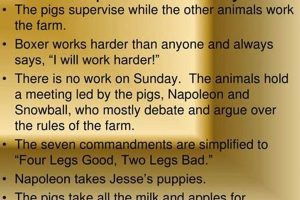
Chapter 3 of Orwell’s Animal Farm depicts the animals’ first harvest under their own management. This segment outlines their initial successes and growing challenges in establishing an egalitarian society. The animals, driven by the principles of Animalism, work diligently to gather the crops. Despite lacking human expertise, their collective effort yields a surprisingly abundant harvest. The narrative emphasizes the animals’ enthusiasm and commitment to the new regime.
The significance of this chapter lies in its illustration of early utopian ideals within the farm’s animal society. It showcases the potential for a more equitable distribution of labor and resources, contrasting sharply with Mr. Jones’s exploitative rule. However, the chapter subtly introduces the seeds of future discord. The pigs, due to their perceived intelligence, begin to take on leadership roles, raising questions about the distribution of power and responsibilities within the community. Furthermore, the inequitable distribution of milk and apples, justified by the pigs’ claim that they need it for brainpower, hints at the emerging inequalities that will eventually undermine the revolution’s initial promise. This sets the stage for the corruption and betrayal that define later chapters. The early successes detailed provide a stark counterpoint to the eventual dystopian reality.
Subsequent analysis will delve into specific events and character interactions within this pivotal chapter, exploring themes of labor distribution, emerging power dynamics, and the initial erosion of Animalism’s core principles. The focus will remain on unpacking the chapter’s complexities, revealing how initial triumphs lay the groundwork for future conflicts and the ultimate failure of the revolution’s initial goals.
Analysis Strategies for Chapter 3
The following suggestions offer approaches to interpreting the content and significance of the third chapter of Orwell’s Animal Farm.
Tip 1: Examine Labor Distribution: Analyze how work is allocated among the animals. Does it reflect the ideals of Animalism, or are there early signs of inequality in the tasks assigned and the burden each animal bears? For example, consider the roles of Boxer, Clover, and the pigs.
Tip 2: Assess the Emerging Power Structure: Identify the initial signs of leadership among the pigs. Note how they justify their decisions and whether other animals challenge their authority. Pay close attention to instances where the pigs claim special privileges based on their intelligence.
Tip 3: Investigate the Allocation of Resources: Critically assess how food, particularly the milk and apples, is distributed. Consider the reasoning the pigs provide and whether it aligns with the principles of Animalism. This distribution serves as a key indicator of the revolution’s developing trajectory.
Tip 4: Trace the Seeds of Corruption: Recognize subtle instances that deviate from the original tenets of Animalism. For instance, the pigs’ manipulation of information or their gradual accumulation of privileges hints at a departure from the intended egalitarianism.
Tip 5: Consider the Chapter’s Foreshadowing: Analyze how the events in Chapter 3 prefigure the later events and eventual collapse of the animal-led society. The seemingly minor discrepancies in this chapter foreshadow the larger inequalities and betrayals to come.
Tip 6: Contrast Idealism with Reality: Explore the juxtaposition between the initial enthusiasm and hard work with the emerging disparities and power dynamics. This contrast highlights the challenges of sustaining a revolution and the susceptibility to corruption.
By carefully considering these elements, a deeper understanding of the underlying themes and the chapter’s importance within the broader narrative will be achieved. The analysis will reveal how seemingly small actions can have significant consequences for the animals’ collective destiny.
Continuing exploration will involve a thorough examination of character motivations and the symbolism embedded within the chapter, contributing to a more complete interpretation of the novel’s critique of power and social change.
1. Successful harvest completion
The successful harvest completion detailed in Animal Farm Chapter 3 is intrinsically linked to the broader narrative captured in that chapter’s events. This initial achievement serves as a foundational element, demonstrating the animals’ capacity for self-governance and collaborative labor, a core tenet of Animalism. The animals, motivated by the newfound freedom from human exploitation, pool their resources and efforts to reap a larger and more efficient harvest than under Mr. Jones’s rule. This early success provides a tangible demonstration of the revolution’s potential benefits, fueling their enthusiasm and solidifying their commitment to the new system. However, it also lays the groundwork for subsequent power dynamics and inequalities that ultimately undermine the revolution’s ideals. The harvest’s success becomes a point of leverage for the pigs, who use it to justify their increasing control and claim on resources.
The connection between a productive harvest and the narrative arc extends beyond mere agricultural accomplishment. This success bolsters the pigs’ perceived authority. Because the harvest is plentiful, their strategic planning is validated, even if the other animals contributed the bulk of the physical labor. This creates a situation where their initial management role solidifies, paving the way for future manipulations. For example, the abundance of food allows the pigs to control distribution, further reinforcing their power. This mirrors historical instances where successful resource management has been used to consolidate authority within revolutionary movements. The Soviet collectivization policies, while drastically different, also initially promised increased agricultural output under collective control, only to result in control and famine.
In conclusion, the successful harvest is not merely an isolated event; it is a crucial catalyst within the narrative of Animal Farm Chapter 3. It reinforces the initial promise of Animalism while simultaneously creating conditions that facilitate the pigs’ rise to power. Understanding this connection is essential to grasping the chapter’s complexity and the subtle ways in which the seeds of corruption are sown within the revolutionary framework. The harvest’s success, therefore, should be viewed as a paradoxical turning point a moment of triumph that contributes to the animals’ eventual subjugation.
2. Pigs' leadership emergence
The emergence of the pigs as leaders is a pivotal element within Animal Farm Chapter 3, directly influencing its narrative progression. It marks the transition from the initial egalitarian ideals of the animal revolution toward a hierarchical structure, a shift initiated under the guise of intellectual superiority and strategic planning. The pigs, claiming a greater understanding of Animalism and a capacity for organization, gradually assume control over decision-making processes related to the farm’s operations, including the distribution of labor and resources. This ascent to leadership is not explicitly contested by the other animals, partly due to the pigs’ perceived intelligence and partly due to the animals’ relative lack of understanding of complex administrative tasks. The chapter subtly showcases how this seemingly innocuous delegation of authority plants the seeds of future oppression and exploitation.
The importance of the pigs’ emerging leadership in Chapter 3 is highlighted by its impact on resource allocation. While the animals initially operate under the principle of equal distribution, the pigs soon manipulate this tenet to their advantage. The instance of the milk and apples serves as a prime example. The pigs justify consuming these resources exclusively, claiming they are essential for maintaining their brainpower and ensuring effective leadership. This subtle shift establishes a precedent for unequal distribution based on perceived value or contribution, effectively dismantling the original promise of equality. This manipulation echoes historical instances where ruling elites have justified their privileged status through claims of superior intellect or expertise. The practical significance of understanding this dynamic lies in recognizing the subtle ways in which power imbalances can arise and be legitimized within revolutionary movements. By examining Chapter 3, one can appreciate how seemingly minor concessions to authority can lead to the erosion of foundational principles.
In essence, the pigs’ leadership emergence is not simply a change in management; it is a catalyst that sets in motion the events leading to the farm’s eventual descent into totalitarianism. Their gradual consolidation of power, masked by claims of necessity and intellectual superiority, undermines the initial promise of Animalism and establishes a framework for exploitation and oppression. The ability to recognize these early signs of power abuse is crucial for understanding the novel’s broader critique of revolutionary movements and their vulnerability to corruption. Chapter 3 serves as a cautionary tale, demonstrating how the best intentions can be subverted by those seeking to consolidate control, highlighting the need for vigilance and skepticism even within seemingly egalitarian systems.
3. Milk and apple allocation
The allocation of milk and apples in Chapter 3 of Animal Farm represents a crucial turning point, highlighting the initial erosion of the revolution’s egalitarian principles. This seemingly minor event serves as a microcosm of the larger power dynamics that will eventually lead to the farm’s descent into totalitarian rule.
- Justification of Privilege
The pigs’ assertion that they require the milk and apples for their brainwork establishes a precedent for unequal distribution justified by perceived necessity. This argument, while presented as being for the common good (maintaining leadership and planning), effectively creates a privileged class with preferential access to resources. This resonates with historical instances where ruling elites have claimed special needs to justify their disproportionate share of wealth and power, such as the divine right of kings or the specialized expertise of technocrats.
- Subversion of Animalism
The pigs’ actions directly contradict the foundational tenets of Animalism, which advocate for equality and shared benefits. The pigs prioritize their needs over those of the other animals, creating a hierarchy that runs counter to the revolution’s original intent. This act reveals the inherent vulnerability of revolutionary ideals to manipulation and self-interest, a theme consistently explored throughout the novel.
- Foundation for Future Exploitation
The unchallenged acceptance of the milk and apple appropriation sets a dangerous precedent for future exploitation. By allowing the pigs to unilaterally determine resource allocation based on subjective criteria, the other animals relinquish control over their well-being and future. This incremental shift in power dynamics allows the pigs to gradually consolidate their authority, leading to further injustices and oppression in later chapters.
- Symbolic Representation of Power Dynamics
The milk and apples function as potent symbols of power and control within the farm’s social structure. They represent not only physical sustenance but also the privilege and authority wielded by the pigs. This symbolic significance underscores the inherent inequalities that emerge within the animal community, foreshadowing the eventual betrayal of the revolution’s core values and the establishment of a new form of tyranny under the pigs’ rule.
The milk and apple incident in Chapter 3 demonstrates how seemingly insignificant acts of inequality can pave the way for larger systemic injustices. This event provides a critical insight into the dynamics of power, manipulation, and the subversion of revolutionary ideals, all of which are central themes explored within the Animal Farm narrative and the understanding of that chapter’s summary.
4. Early inequality signs
Early inequality signs within the narrative of Animal Farm Chapter 3 are intrinsically linked to the overall understanding of that chapter’s summary. These emerging disparities function as critical plot devices, foreshadowing the corruption of the revolution’s initial ideals and setting the stage for the farm’s eventual descent into totalitarian rule. The subtle emergence of privilege and unequal access to resources, while seemingly minor at first glance, constitutes a foundational element in the chapter’s trajectory and is indispensable for a comprehensive understanding.
The distribution of milk and apples, for instance, is a potent example of an early inequality sign. The pigs justify their exclusive consumption of these resources by claiming a need for enhanced brainpower, essential for the planning and management of the farm. This justification, while presented under the guise of the common good, establishes a clear hierarchy wherein certain animals are deemed more valuable and deserving than others. The unchallenged acceptance of this inequality by the other animals underscores their naivete and willingness to trust the pigs’ leadership. Moreover, it establishes a precedent for future exploitative practices and the gradual erosion of the original principles of Animalism. Historically, nascent inequalities within revolutionary movements have often served as indicators of impending corruption and the establishment of new forms of oppression, mirroring events such as the stratification of Soviet society after the Russian Revolution.
Understanding the significance of these early inequality signs within the context of the chapter is crucial for interpreting the broader themes of Animal Farm. They are not merely isolated incidents but rather integral components of the narrative arc, revealing the inherent challenges in maintaining revolutionary ideals and the susceptibility of social structures to corruption and abuse of power. Recognizing the role of seemingly minor inequalities in paving the way for larger systemic injustices is paramount to grasping the chapter’s cautionary message and its relevance to the understanding of the overall critique of utopian societies gone awry. By recognizing the “Early inequality signs”, the summary becomes not just a recounting of events, but an insightful interpretation of the revolution’s decay.
5. Boxer's dedicated labor
Boxer’s unwavering commitment to labor forms a central pillar of Chapter 3 of Animal Farm, profoundly influencing the chapter’s narrative and symbolic weight. His tireless efforts contribute significantly to the animals’ successful harvest, a feat that initially validates the revolution’s potential for prosperity and self-sufficiency. This dedication, however, is exploited by the emerging pig leadership, who leverage Boxer’s unwavering loyalty and physical strength to further their own agenda. Boxer’s mantra, “I will work harder,” encapsulates his unyielding work ethic, which is strategically used to drive the farm’s productivity while simultaneously reinforcing the pigs’ control. His labor, therefore, is not merely a contribution to the collective; it becomes a tool for manipulation, highlighting the dangers of blind faith and unquestioning obedience.
Boxer’s role as the farm’s primary workhorse underscores the disparity between the revolutionary ideals and the emerging reality. While the pigs increasingly delegate labor and enjoy the fruits of the harvest, Boxer shoulders the burden of physical work, embodying the exploitation masked by utopian rhetoric. This dynamic parallels historical instances where the working class has been exploited under the banner of collective progress. The Soviet Stakhanovite movement, for example, celebrated individual workers who exceeded production quotas, inadvertently creating a system that further pressured laborers to meet unrealistic expectations. Understanding this connection is crucial for appreciating the nuances of Chapter 3 and its critique of power structures. Boxer’s willingness to sacrifice himself for the supposed betterment of the farm, coupled with the pigs’ manipulative use of his labor, serves as a cautionary tale about the vulnerability of individuals to ideological exploitation.
Ultimately, Boxer’s dedicated labor in Chapter 3 is not simply a demonstration of hard work; it is a poignant illustration of the revolution’s corruption. His unwavering commitment, initially intended to build a better society, is twisted into a means of consolidating the pigs’ power and reinforcing a system of inequality. The chapter’s summary cannot be fully grasped without acknowledging Boxer’s central role in this process, emphasizing the importance of critical analysis and skepticism in the face of seemingly benevolent authority. His tragic trajectory underscores the novel’s broader critique of revolutionary movements and their susceptibility to betrayal, leaving readers with a stark reminder of the potential consequences of unchecked power and unquestioning obedience.
Frequently Asked Questions About Chapter 3 of Animal Farm
The following section addresses common inquiries regarding the content, themes, and significance of the third chapter of George Orwell’s Animal Farm.
Question 1: What is the central event depicted in Chapter 3?
The central event is the animals’ successful completion of their first harvest under their own management, demonstrating their capacity for self-governance and collective labor.
Question 2: How does Chapter 3 contribute to the novel’s overall narrative?
Chapter 3 is pivotal as it establishes the initial promise of Animalism while simultaneously introducing the seeds of corruption that will eventually lead to the farm’s downfall.
Question 3: What role do the pigs play in Chapter 3?
The pigs begin to assert their leadership, claiming intellectual superiority and gradually assuming control over decision-making processes, including resource allocation and labor distribution.
Question 4: What is the significance of the milk and apples in this chapter?
The unequal allocation of milk and apples to the pigs serves as an early sign of inequality and a violation of Animalism’s principles, foreshadowing the pigs’ eventual exploitation of the other animals.
Question 5: What is Boxer’s contribution to the events of Chapter 3?
Boxer’s unwavering commitment to labor and his tireless efforts are instrumental in the harvest’s success. However, his dedication is exploited by the pigs, who manipulate his loyalty for their own gain.
Question 6: How does Chapter 3 foreshadow future events in the novel?
The chapter establishes the dynamics of power and control that will become increasingly pronounced as the narrative progresses. The subtle inequalities and the pigs’ growing dominance foreshadow the farm’s descent into totalitarianism.
Chapter 3 is crucial for understanding the novel’s critique of revolutionary movements and the potential for corruption within seemingly utopian societies. The events detailed in this chapter set the stage for the subsequent tragedies and betrayals that define Animal Farm.
The next section will explore the thematic elements within the text.
Summary Animal Farm Chapter 3
The preceding analysis underscores the vital role a meticulous examination of summary animal farm chapter 3 plays in understanding Orwell’s allegorical masterpiece. The events within this chapter, while initially presenting an image of successful revolution, are revealed as critical indicators of Animal Farm’s impending descent into tyranny. The emerging power dynamics, particularly the pigs’ ascent to leadership and the justification of resource inequality, foreshadow the complete subversion of Animalism’s original principles. Boxer’s unwavering dedication, paradoxically, contributes to this decline as it provides the labor upon which the pigs’ control is built.
A comprehensive understanding of Chapter 3 necessitates careful consideration of its seemingly subtle details, which ultimately foreshadow the tragic trajectory of Animal Farm. The chapter offers a cautionary lesson about the inherent challenges of revolutionary movements and the ever-present danger of corruption, demanding vigilant scrutiny of power structures and a commitment to safeguarding the foundational ideals of equality and justice. Failure to heed the warnings embedded within summary animal farm chapter 3 risks repeating the dystopian fate of the animals trapped within its narrative. Further research and critical engagement with Orwell’s work are strongly encouraged.