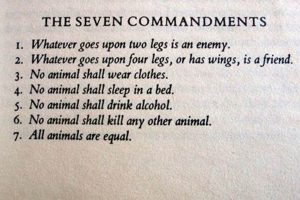
The foundational principles established early in the narrative serve as the cornerstone of the newly formed society. Initially intended to ensure equality and prevent the exploitation experienced under human ownership, these guidelines are designed to govern the behavior of all residents and maintain order within the revolutionary framework. An example includes the declaration that “Whatever goes upon two legs is an enemy,” intended to solidify the distinction between animals and humans, thereby preventing any reversion to the oppressive past. These tenets represent the animals’ aspiration for a utopian existence free from tyranny.
These principles’ significance lies in their potential to create a just and equitable community. They represent a collective agreement to prioritize the well-being of all members and prevent the abuses of power that characterized the previous regime. Historically, such idealistic frameworks have often emerged in the wake of revolutions, serving as a means to establish new social norms and safeguard against the recurrence of past injustices. The original intent fosters unity and shared purpose among the community, offering a path toward a more fulfilling existence.
The subsequent discussion will delve into the specific content of each principle, examining its intended purpose and analyzing the ways in which these ideals are progressively undermined and manipulated throughout the storyline, ultimately leading to the complete subversion of the original revolutionary goals.
Insights Derived from Foundational Principles
The degradation of societal values within the allegorical setting offers valuable lessons regarding the preservation of ethical standards and the avoidance of authoritarianism.
Tip 1: Maintain Vigilance Against Revisionism: Principles, however well-intentioned, are susceptible to reinterpretation and manipulation. Close scrutiny must be maintained to ensure that foundational tenets are not twisted to serve ulterior motives, as demonstrated by the gradual modification of commandments to justify actions.
Tip 2: Empower Educated Participation: A population lacking critical thinking skills and an understanding of core principles is easily swayed by propaganda and misinformation. Cultivating widespread education and fostering open discourse are vital safeguards against manipulation and the erosion of foundational values. The unquestioning acceptance of Squealer’s pronouncements serves as a cautionary example.
Tip 3: Resist the Allure of Simplified Solutions: Complex societal challenges rarely have simple answers. Appeals to emotion and the promise of immediate solutions can be deceptive tactics employed to gain control. A critical approach to rhetoric and a willingness to engage with nuanced perspectives are essential for informed decision-making.
Tip 4: Uphold Transparency and Accountability: Power vacuums and a lack of transparency create fertile ground for corruption. Establishing robust mechanisms for oversight and holding leaders accountable for their actions are crucial for preventing the abuse of authority. The pigs’ gradual accumulation of power, unchecked by any meaningful opposition, exemplifies this danger.
Tip 5: Value Collective Memory and Historical Awareness: A society that forgets its past is doomed to repeat it. Remembering the reasons why foundational principles were established and the sacrifices made to achieve them provides a powerful deterrent against backsliding and the recurrence of past mistakes.
These insights underscore the importance of active participation, critical thinking, and a commitment to ethical governance in maintaining a just and equitable society.
The concluding section will provide a summary of key themes and their relevance to contemporary societal challenges.
1. Foundation
The “foundation” represents the core principles upon which the new society is built, directly corresponding to the initial formulation of the “7 rules of animal farm.” These principles are intended to define the values and structures of the revolutionary framework and ensure a departure from the oppressive conditions of the past. The integrity of this “foundation” directly impacts the future stability and equity of the society.
- Equality as a Cornerstone
The principle of equality among all animals is the bedrock of the revolution. It is manifested in the initial declaration of equal rights and responsibilities, designed to prevent the emergence of hierarchies and exploitation. In practice, equality requires active measures to ensure that all members have access to resources and opportunities, regardless of their individual capabilities. In the context of “7 rules of animal farm,” the erosion of equality begins with the pigs’ gradual accumulation of privileges, ultimately undermining the foundational ideal.
- The Rule of Law and Governance
The establishment of a clear and just legal framework is essential for maintaining order and preventing the abuse of power. The “7 rules of animal farm” serve as the initial constitution, defining acceptable behavior and outlining the consequences for transgressions. However, the effectiveness of any legal system depends on its impartial enforcement and the transparency of its procedures. The progressive manipulation of the commandments by the pigs demonstrates the fragility of the “foundation” when the rule of law is compromised.
- Collective Identity and Purpose
A shared sense of identity and purpose is crucial for fostering unity and cooperation within the community. The “7 rules of animal farm” contribute to this sense of collective identity by defining what it means to be an “animal” as opposed to a “human.” This shared identity helps to mobilize support for the revolution and encourages individuals to work together for the common good. However, the manipulation of language and propaganda can be used to distort this collective identity and divide the community, weakening the “foundation.”
- Economic Principles and Resource Allocation
The equitable distribution of resources is essential for ensuring the well-being of all members and preventing economic inequality. The initial economic model of Animal Farm is based on collective ownership and shared labor, with the aim of eliminating the exploitation experienced under Mr. Jones. However, the pigs’ control over resources and their manipulation of the economic system gradually lead to the re-emergence of inequality, undermining the “foundation” of economic justice.
The “foundation,” represented by the “7 rules of animal farm,” is not a static entity but a dynamic process that requires constant vigilance and active participation from all members of the society. The erosion of these foundational principles ultimately leads to the collapse of the revolutionary vision and the re-establishment of tyranny. The story serves as a cautionary tale about the importance of preserving ethical standards and resisting the allure of unchecked power.
2. Equality
The concept of equality forms the philosophical cornerstone of the “7 rules of animal farm.” The impetus for the animal rebellion stems directly from the perceived and experienced inequality under human ownership. Animals endure forced labor, limited resources, and the constant threat of violence. The principles, therefore, aim to rectify this imbalance by establishing a social order where all animals are treated as equals, sharing in the fruits of their labor and possessing equal rights. This commitment is explicitly articulated in the initial formulation of the commandments, particularly in the declaration that “All animals are equal.” However, the subsequent narrative illustrates the fragility of this ideal and the ease with which it can be corrupted.
The importance of equality as a component is multifaceted. First, it provides the moral justification for the revolution, framing it as a struggle for justice and liberation. Second, it serves as a unifying force, fostering solidarity among diverse animal species. Third, it establishes a standard against which the actions of the new leadership, specifically the pigs, can be judged. The manipulation of this principle, exemplified by the alteration of the key commandment to “All animals are equal, but some animals are more equal than others,” exposes the hypocrisy and betrayal at the heart of the story. Real-world examples of revolutions demonstrate similar patterns, where initial promises of equality often give way to new forms of inequality and oppression. The French Revolution, for instance, despite its commitment to “liberty, equality, fraternity,” ultimately resulted in the rise of Napoleon and a new imperial regime. The Russian Revolution, similarly, saw the emergence of a totalitarian state under Stalin, where a privileged elite controlled power and resources. These historical parallels underscore the enduring challenge of translating idealistic principles into sustainable social realities.
Understanding the connection between equality and the principles has practical significance for analyzing power dynamics and social justice movements. It highlights the dangers of unchecked authority and the importance of maintaining vigilance against the erosion of fundamental rights. It also underscores the need for robust mechanisms of accountability and transparency to prevent the concentration of power in the hands of a few. By recognizing the subtle ways in which equality can be undermined, individuals can become more active and informed participants in shaping a just and equitable society. The story serves as a reminder that the pursuit of equality is an ongoing process, requiring constant effort and a willingness to challenge injustice wherever it is found.
3. Revolution
The “7 rules of animal farm” are inextricably linked to the revolution that overthrows Mr. Jones. These principles serve as both a justification for the uprising and a blueprint for the new society. The revolution is a direct response to the animals’ suffering under human rule, fueled by a desire for freedom and self-determination. The principles articulate the core values of this revolution, promising a society free from oppression and exploitation. They provide a framework for organizing the community and establishing a new social order based on equality and mutual cooperation. Without the revolution, the principles would be merely abstract ideals; conversely, without the principles, the revolution would lack a clear direction and purpose.
The importance of revolution as a component within the context of “7 rules of animal farm” lies in its catalytic role. It is the event that sets in motion the entire sequence of events depicted in the allegory. The revolution’s initial success creates a sense of hope and possibility, motivating the animals to work together towards a better future. However, the subsequent corruption of the revolutionary ideals highlights the challenges of maintaining integrity and preventing the abuse of power in the aftermath of upheaval. Historical examples of revolutions, such as the Russian Revolution and the Cuban Revolution, demonstrate similar patterns. In each case, initial promises of liberation and equality were ultimately betrayed by authoritarian regimes that consolidated power and suppressed dissent. These real-world parallels underscore the importance of vigilance and accountability in safeguarding revolutionary gains. Furthermore, a well-defined and consistently applied set of rules is essential to prevent the descent into chaos and maintain the original goals. The absence of these will likely lead to a situation mirroring the end where conditions were only marginally better than before the change.
Understanding the interplay between revolution and the “7 rules of animal farm” provides valuable insights into the dynamics of social change. It underscores the need for clear and consistent principles to guide revolutionary movements and prevent the erosion of their ideals. It also highlights the importance of participatory governance, accountability, and a commitment to social justice in sustaining a truly revolutionary transformation. The story serves as a cautionary tale, reminding us that revolution alone is not enough to guarantee a better future; it must be accompanied by a steadfast commitment to the principles of equality, justice, and freedom.
4. Betrayal
The theme of betrayal is central to understanding the “7 rules of animal farm” and the narrative’s descent into tyranny. The rules, initially conceived as a safeguard against human exploitation and a foundation for equality, are progressively undermined and manipulated by the pigs, who ultimately betray the trust and ideals of the other animals. This betrayal is not a single event but a gradual process, beginning with subtle privileges and escalating to outright oppression. The cause of this betrayal lies in the pigs’ ambition for power and their willingness to compromise the revolution’s principles for personal gain. The effect is the gradual erosion of the animals’ freedom and well-being, culminating in a society more oppressive than that under Mr. Jones.
The importance of betrayal as a component is paramount because it demonstrates the fragility of revolutionary ideals and the dangers of unchecked authority. The principles themselves become instruments of betrayal, as they are reinterpreted and twisted to justify the pigs’ actions. For example, the commandment “No animal shall sleep in a bed” is altered to “No animal shall sleep in a bed with sheets,” allowing the pigs to enjoy the comfort of beds while maintaining the illusion of adherence to the rules. This illustrates how seemingly minor revisions can pave the way for more significant abuses of power. Historical examples abound, where revolutionary movements have been betrayed by their leaders. The rise of Stalin in the Soviet Union, for instance, represents a profound betrayal of the socialist ideals that inspired the revolution. Similarly, the Reign of Terror during the French Revolution saw the ideals of liberty, equality, and fraternity sacrificed to political expediency. These examples highlight the enduring risk of betrayal in any revolutionary context.
Understanding the connection between betrayal and the principles has significant practical implications. It underscores the need for constant vigilance against the abuse of power and the importance of establishing robust mechanisms for accountability and transparency. It also emphasizes the role of critical thinking and education in empowering citizens to resist manipulation and defend their rights. The story serves as a cautionary tale, reminding us that revolutionary ideals must be constantly defended against those who would seek to exploit them for personal gain. The systematic dismantling of the farm and its vision, highlights a recurring theme in humanity’s societal structure, requiring continued effort to mitigate the damage.
5. Manipulation
Manipulation is intrinsically woven into the fabric of “7 rules of animal farm,” serving as the primary mechanism through which the pigs gradually consolidate power and subvert the original egalitarian ideals. The principles, initially intended to safeguard against exploitation, become tools for control. The pigs, led by Napoleon and aided by Squealer’s persuasive rhetoric, skillfully distort the meaning and application of the tenets to justify their self-serving actions. This manipulation is not merely a matter of changing the words of the commandments; it involves a systematic campaign of disinformation, propaganda, and psychological coercion designed to maintain the animals’ obedience and suppress dissent. The cause is the pigs insatiable desire for control, while the effect is the gradual erosion of the animals freedom and the re-establishment of a hierarchical society.
The importance of manipulation as a component of “7 rules of animal farm” lies in its ability to expose the fragility of truth and the vulnerability of individuals to deceptive tactics. Squealer’s ability to convince the animals that “black is white” demonstrates the power of propaganda to distort reality and control public opinion. The manipulation of language is particularly effective, as the pigs redefine words and concepts to suit their own purposes. For example, “equality” becomes synonymous with “some are more equal than others,” effectively negating the original meaning of the term. This manipulation extends to historical records, as the pigs rewrite the past to erase any evidence of their transgressions and create a narrative that supports their authority. Numerous historical examples illustrate the devastating consequences of manipulation in political contexts. The Nazi regime’s use of propaganda to demonize Jews and justify the Holocaust is a stark reminder of the dangers of unchecked manipulation. Similarly, the Soviet Union’s use of disinformation and censorship to control its population demonstrates the power of manipulation to suppress dissent and maintain authoritarian rule.
Understanding the connection between manipulation and the principles has significant practical implications for navigating the complexities of modern society. It underscores the need for critical thinking skills, media literacy, and a healthy skepticism towards authority. It also highlights the importance of independent sources of information and the protection of freedom of speech. By recognizing the subtle ways in which manipulation can occur, individuals can become more resilient to its influence and more effective in defending their rights and freedoms. “7 rules of animal farm” remains a powerful allegory for the dangers of manipulation and the importance of safeguarding truth and integrity in any society, as it warns against the abuse of power and promotes individual responsibility to combat manipulation.
6. Tyranny
In the context of “7 rules of animal farm,” tyranny represents the ultimate outcome of the corruption and manipulation of the initial principles. It is the state of absolute power wielded by the pigs, resulting in the oppression and exploitation of the other animals. This tyranny emerges not as a sudden imposition, but as a gradual and insidious process, fueled by the pigs’ ambition and the animals’ passivity. The “7 rules of animal farm,” originally intended to prevent tyranny, become the very instruments through which it is established.
- Suppression of Dissent
One of the hallmarks of tyranny is the suppression of any form of dissent or opposition. In “7 rules of animal farm,” this is manifested through the silencing of Snowball, the execution of animals accused of treason, and the constant propaganda disseminated by Squealer. Historically, tyrannical regimes often employ similar tactics, including censorship, imprisonment, and violence, to silence their critics and maintain control. The implications within the story are clear: the absence of free speech and open debate allows the pigs to consolidate their power unchallenged.
- Control of Information
Tyranny thrives on the control of information. The pigs systematically rewrite history, distort facts, and disseminate propaganda to maintain their grip on power. By controlling what the animals know and believe, they can manipulate their perceptions and prevent them from questioning the regime. This tactic is mirrored in real-world examples, such as the totalitarian states of the 20th century, where governments controlled the media and suppressed dissenting voices. The story’s manipulation highlights the importance of independent sources of information and a critical approach to evaluating information.
- Erosion of Equality
Equality, initially the cornerstone of the revolution, is systematically eroded under the pigs’ tyrannical rule. The principle that “all animals are equal” is replaced by the insidious assertion that “all animals are equal, but some animals are more equal than others.” This blatant contradiction exposes the hypocrisy of the regime and demonstrates how easily revolutionary ideals can be subverted. The pigs enjoy privileges and comforts denied to the other animals, creating a stark social hierarchy that mirrors the inequalities of the previous regime. The story reminds readers that equality is not simply a matter of legal pronouncements, but requires constant vigilance and active enforcement.
- Abuse of Power
At its core, tyranny is characterized by the abuse of power. The pigs exploit their position of authority to enrich themselves, oppress the other animals, and maintain their control. They use violence, intimidation, and propaganda to silence dissent and ensure obedience. This abuse of power is a common feature of tyrannical regimes throughout history, from ancient empires to modern dictatorships. The implication in “7 rules of animal farm” is that power corrupts, and that even those who begin with noble intentions can succumb to the temptation to abuse their authority.
These facets of tyranny, as depicted in “7 rules of animal farm,” underscore the fragility of revolutionary ideals and the constant threat of authoritarianism. The story serves as a warning against the dangers of unchecked power and the importance of safeguarding individual rights and freedoms. By examining the mechanisms through which tyranny is established and maintained, readers can gain a deeper understanding of the challenges of building and sustaining a just and equitable society.
Frequently Asked Questions Regarding Foundational Principles
This section addresses common inquiries concerning the application, interpretation, and legacy of the foundational principles initially established within the allegorical setting.
Question 1: What were the original motivations behind establishing the “7 rules of animal farm?”
The primary motivation was to create a social framework preventing the exploitation and oppression experienced under human ownership. These principles aimed to enshrine equality, promote collective well-being, and prevent the re-emergence of hierarchical power structures.
Question 2: How did the interpretation of the principles change over time?
The interpretation underwent a gradual and systematic transformation, orchestrated by the pigs. Initial interpretations emphasized equality and mutual cooperation. Subsequent interpretations were increasingly self-serving, designed to justify the pigs’ privileges and consolidate their control.
Question 3: What role did language play in the manipulation of the “7 rules of animal farm?”
Language served as a crucial tool for manipulation. The pigs employed euphemisms, propaganda, and outright falsehoods to distort the meaning of the principles and control the animals’ perceptions. This manipulation extended to rewriting history and suppressing dissenting voices.
Question 4: How did the other animals contribute to the subversion of the principles?
The other animals’ passivity, ignorance, and lack of critical thinking skills facilitated the pigs’ manipulation. Their unquestioning obedience and inability to recognize the subtle distortions of the principles allowed the pigs to consolidate their power unchallenged.
Question 5: What parallels exist between the allegorical narrative and real-world historical events?
Significant parallels can be drawn to various revolutionary movements and totalitarian regimes throughout history. The Russian Revolution, the rise of Stalin, and the abuses of power in other authoritarian states offer compelling examples of how revolutionary ideals can be betrayed and manipulated.
Question 6: What lasting lessons can be derived from the story regarding the preservation of ethical standards?
The narrative underscores the importance of vigilance against the abuse of power, the need for critical thinking and informed participation, and the necessity of establishing robust mechanisms for accountability and transparency in any social or political system. The importance of defending truth and resisting manipulation are also important themes.
The systematic subversion of these principles offers valuable insights into the challenges of maintaining a just and equitable society.
The next article will be about case study of “7 rules of animal farm”.
Concluding Observations
The exploration of the “7 rules of animal farm” reveals a cautionary narrative regarding the subversion of revolutionary ideals. The initial promise of equality and liberation is systematically undermined through manipulation, betrayal, and the unchecked consolidation of power. The transformation of these principles from safeguards against tyranny into instruments of oppression underscores the fragility of ethical foundations in the face of ambition and unchecked authority.
The allegorical representation of societal decay serves as a potent reminder of the enduring challenges in establishing and maintaining a just and equitable society. Vigilance, critical thinking, and a commitment to safeguarding truth remain essential for preventing the erosion of fundamental principles and ensuring that revolutionary aspirations do not succumb to the corrupting influence of power. The lessons embedded within this narrative warrant ongoing reflection and proactive engagement in promoting ethical governance and resisting the allure of authoritarianism. The continuous guarding of our values is what separates us from repeating the mistakes of the past.