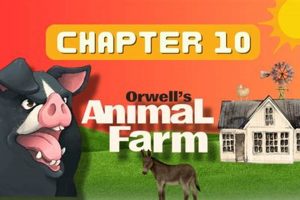
The narrative centers on a group of farm animals who overthrow their human farmer and establish an egalitarian society. This initial revolution, fueled by ideals of equality and freedom from oppression, soon deteriorates under the leadership of the pigs, who gradually assume control and establish a totalitarian regime. The allegory uses animals to represent various figures and social classes involved in the Russian Revolution and the subsequent Stalinist era. Each animal’s characteristics and actions mirror specific political figures or societal groups, providing a symbolic representation of the historical events.
The importance lies in its enduring relevance as a commentary on political corruption, social stratification, and the dangers of unchecked power. Its benefit arises from its ability to simplify complex historical and political concepts, making them accessible to a wide audience. The work serves as a cautionary tale, highlighting how utopian ideals can be subverted and exploited, leading to oppression that mirrors, or even surpasses, the original tyranny it sought to overthrow. The book’s impact is significant due to its ability to engage readers in critical thinking about political systems and the importance of vigilance in safeguarding individual liberties.
Further exploration of the text will reveal nuanced interpretations of the characters and events, detailing the pigs’ manipulation tactics, the gradual erosion of the original revolutionary principles, and the ultimate disillusionment of the other animals. An analysis of specific characters, such as Napoleon and Snowball, and their respective roles in the farm’s descent into totalitarianism provides a deeper understanding of the book’s core message. Understanding the symbolic weight of the barn, the commandments, and the windmill enriches the appreciation of the story’s allegorical nature.
Insights Gleaned from Animal Farm
Critical analysis of George Orwell’s Animal Farm provides enduring insights into the nature of power, revolution, and societal corruption. The following observations distill key lessons from the allegorical narrative.
Tip 1: Recognize the Fragility of Revolutionary Ideals: Initial revolutionary fervor and principles are susceptible to corruption and manipulation. Maintaining vigilance and adhering to core values is essential for long-term success.
Tip 2: Scrutinize Leadership Ambitions: Observe leaders’ actions, not merely their rhetoric. Power-hungry individuals often exploit popular sentiment to advance their own agendas, undermining the revolution’s original goals.
Tip 3: Be Wary of Propaganda and Control of Information: Controlling information is a potent tool for maintaining power. Actively seek diverse perspectives and question narratives presented by those in authority.
Tip 4: Understand the Importance of Education and Critical Thinking: Ignorance and lack of critical thinking make individuals vulnerable to manipulation. Education empowers individuals to discern truth from falsehood and resist oppressive forces.
Tip 5: Resist Gradual Erosion of Rights and Freedoms: Incremental changes that undermine fundamental rights can lead to totalitarianism. Constant vigilance and resistance to even minor infringements are crucial.
Tip 6: Recognize the Dangers of Social Stratification: Unequal distribution of resources and power breeds resentment and instability. Egalitarian principles must be actively maintained to prevent the emergence of new forms of oppression.
Tip 7: Acknowledge the Role of Language in Shaping Reality: Language can be used to distort truth, manipulate public opinion, and justify oppressive actions. Pay close attention to the words used by those in power and their potential for deception.
The cautionary narrative underscores the importance of individual responsibility, critical thinking, and active participation in safeguarding democratic principles. The book serves as a stark reminder that revolutions, even those born of noble intentions, can devolve into tyranny if vigilance is not maintained.
The enduring legacy resides in its ability to provoke critical reflection on the dynamics of power and the ongoing struggle to preserve freedom and justice in the face of human fallibility.
1. Revolution's Betrayal
The betrayal of revolutionary ideals constitutes a central theme within the narrative, significantly shaping the overall “summary of the book animal farm by george orwell”. The initial promise of equality and liberation is progressively undermined, leading to a state of oppression worse than the original tyranny. This dynamic is pivotal to understanding the book’s cautionary message.
- Erosion of Equality
The foundational principle of equality, initially enshrined in the Seven Commandments, is systematically eroded. The pigs, through subtle alterations and blatant disregard, create a hierarchy where “some animals are more equal than others.” This subversion of the revolution’s core tenet represents a fundamental betrayal of the animals’ collective aspirations for a just society. This process mirrors historical instances where revolutionary movements, promising egalitarianism, descend into authoritarianism with new elites replacing the old.
- Manipulation of Language and History
The pigs rewrite history and manipulate language to control the narrative and justify their actions. Squealer’s persuasive rhetoric and the constant revision of the Commandments demonstrate how language can be used to distort reality and maintain power. This control of information prevents the other animals from recognizing the extent of the betrayal and effectively silences dissent. This facet is reflected in totalitarian regimes where propaganda and censorship are employed to suppress opposing viewpoints and maintain control.
- Exploitation of Labor
The other animals, particularly Boxer, are subjected to relentless labor with the promise of a better future. However, the fruits of their labor are disproportionately enjoyed by the pigs, who live in comfort while the other animals endure hardship and scarcity. This exploitation of the working class, under the guise of collective benefit, represents a significant betrayal of the revolution’s promise of economic justice. This element resonates with historical criticisms of communist states where the ruling class benefited at the expense of the working population.
- Adoption of Human Traits
The pigs gradually adopt the traits and behaviors of the humans they initially overthrew, engaging in trade, sleeping in beds, and walking on two legs. This assimilation symbolizes the complete abandonment of the revolutionary principles and the embrace of the very system they sought to replace. This transformation underscores the cyclical nature of power and the tendency for revolutions to replicate the structures they initially opposed. The visual of pigs playing cards with humans at the end epitomizes this betrayal of the original cause.
These facets of betrayal, interwoven throughout the narrative, contribute to the overall cautionary tale. The transformation from a utopian vision to a dystopian reality highlights the fragility of revolutionary ideals and the constant vigilance required to safeguard against corruption and oppression, solidifying its importance in the “summary of the book animal farm by george orwell”.
2. Power Corrupts
The aphorism “Power corrupts, and absolute power corrupts absolutely” serves as a central tenet in understanding the “summary of the book animal farm by george orwell”. The narrative illustrates how the acquisition and consolidation of power invariably lead to moral decay, ultimately transforming a revolutionary ideal into a totalitarian nightmare.
- The Pigs’ Gradual Ascent
Initially, the pigs are seen as intelligent leaders capable of guiding the other animals. However, their inherent desire for control and comfort gradually overshadows their commitment to the revolution’s initial principles. This slow and insidious process reveals how power, even when initially wielded with good intentions, can corrupt individuals and distort their values. The shift from collective decision-making to autocratic rule exemplifies this corruption in action. The transition from democratic meetings to decisions made solely by Napoleon demonstrates this shift.
- Manipulation of Information
Controlling information is a key tactic employed by the pigs to maintain their power. Squealer’s role as chief propagandist demonstrates how truth can be twisted and manipulated to justify the pigs’ actions and suppress dissent. The rewriting of history and the constant revision of the Seven Commandments highlights the power of propaganda to control the narrative and maintain control, effectively deceiving the other animals and preventing them from recognizing the pigs’ corruption. This is mirrored in real-world examples of authoritarian regimes using state-controlled media to disseminate misinformation and suppress opposing viewpoints.
- Exploitation of the Masses
The pigs exploit the labor of the other animals for their own benefit, enjoying a life of luxury while the others endure hardship and scarcity. This exploitation reveals how power can lead to the abuse and oppression of those who are less powerful. Boxer’s unwavering loyalty and relentless work ethic are ultimately exploited, symbolizing the vulnerability of the working class to those in power. This mirrors historical examples of ruling elites exploiting the labor of the masses for their own enrichment.
- Abandonment of Principles
The pigs progressively abandon the core principles of Animalism, engaging in behaviors that were initially condemned as human-like, such as sleeping in beds, drinking alcohol, and trading with humans. This abandonment represents the complete corruption of the revolution’s ideals and the embrace of the very system they sought to overthrow. The pigs’ transformation into indistinguishable figures from the humans they ousted underscores the cyclical nature of power and the tendency for revolutions to replicate the structures they initially opposed. This resonates with historical instances where revolutionary movements, after achieving power, adopt the practices and values of the previous regime.
These elements, interwoven throughout the narrative, serve as a potent illustration of how power, when unchecked, inevitably leads to corruption and oppression. The narrative serves as a cautionary tale, highlighting the importance of vigilance and accountability in safeguarding against the abuse of power, reinforcing its significance in relation to the narrative.
3. Pigs' manipulation
The pigs’ manipulation constitutes a cornerstone in comprehending a comprehensive “summary of the book animal farm by george orwell.” This manipulation, multifaceted in its execution, serves as the primary catalyst for the farm’s descent from revolutionary idealism to totalitarian control. The manipulation is not merely a subplot; it is the driving force behind the plot’s progression and the thematic exploration of power’s corrupting influence. The effectiveness of their methods, which include propaganda, revisionism, and exploitation, directly determines the animals’ inability to resist the pigs’ oppressive regime. Consequently, the pigs’ manipulation transforms the farm into a distorted image of its original utopian aspiration.
Propaganda, disseminated primarily through Squealer, serves as a potent tool. He skillfully distorts facts, reinterprets events, and manufactures narratives to justify the pigs’ actions and suppress dissent. For example, the changing of the Seven Commandments, often under the cover of night, subtly alters the farm’s foundational principles to align with the pigs’ self-serving agenda. These changes, presented as necessary adjustments for the common good, mask the pigs’ increasing control and the erosion of the other animals’ rights. This is directly analogous to historical instances where totalitarian regimes employ propaganda to control public opinion and maintain power, such as the Soviet Union’s manipulation of information under Stalin.
In conclusion, the manipulation perpetrated by the pigs is not simply a detail within the narrative; it represents the core mechanism through which the revolution is subverted and totalitarianism is established. Comprehending the nature and extent of this manipulation is thus indispensable for understanding its enduring message and the practical implications for recognizing and resisting manipulative tactics in any societal context. Understanding the pigs’ manipulation, therefore, offers critical insights into the dangers of unchecked power and the importance of critical thinking in safeguarding freedom and equality.
4. Class divide
The emergence and perpetuation of class divide constitute a fundamental element in understanding the thematic complexities within a “summary of the book animal farm by george orwell.” The story illustrates how initial egalitarian aspirations can be undermined by the creation of distinct social strata, fostering inequality and ultimately leading to oppression.
- The Pigs’ Ascendancy to Privilege
The pigs, initially regarded as intellectual leaders, gradually exploit their position to gain preferential treatment. They claim exclusive rights to resources like milk and apples, justifying their actions with claims of intellectual superiority and the necessity of preserving their health for the good of the farm. This establishes a clear delineation between the ruling class (the pigs) and the working class (the other animals), mirroring historical examples of social stratification where a select few control resources and power at the expense of the majority. The privileges enjoyed by the pigs are rationalized under the guise of benefiting the entire farm, a common tactic used by ruling classes to legitimize their dominance.
- Exploitation of the Working Class
Animals like Boxer and Clover represent the working class, characterized by their unwavering loyalty and relentless labor. They are exploited for their physical strength and commitment to the farm’s progress, receiving minimal rewards in return. Their unwavering belief in the revolution and their leaders blinds them to the growing inequality. This reflects historical patterns where the working class is often subjected to harsh conditions and economic exploitation while contributing significantly to societal wealth and progress. The animals’ inability to question the pigs’ authority perpetuates this cycle of exploitation.
- Control of Knowledge and Education
The pigs control access to education and knowledge, further solidifying the class divide. They teach the sheep simplistic slogans like “Four legs good, two legs bad,” preventing them from engaging in critical thinking and questioning the pigs’ authority. The other animals remain ignorant of the true nature of their situation, making them susceptible to manipulation and control. This resonates with historical instances where ruling classes limit access to education and information to maintain their dominance and suppress dissent. The denial of education to the masses ensures their continued subjugation.
- Unequal Distribution of Resources
The distribution of food, shelter, and other essential resources becomes increasingly unequal over time. The pigs enjoy comfortable living conditions and abundant food supplies, while the other animals often face scarcity and hardship. This disparity reflects real-world examples of wealth inequality, where a small percentage of the population controls a disproportionate share of resources. The unequal distribution fuels resentment and social instability, ultimately contributing to the farm’s dystopian state. The pigs’ appropriation of the best resources mirrors the hoarding of wealth by elites in many societies.
These facets of class divide, intricately woven into the narrative, underscore its significance as a commentary on social inequality and its consequences. The degeneration highlights the inherent dangers of unchecked power and the importance of vigilance in preventing the emergence of social hierarchies, thereby underscoring the power and significance of the summary of the book animal farm by george orwell.
5. Lost ideals
The erosion of initial revolutionary principles constitutes a pivotal element in a comprehensive summary. The narrative commences with a fervent desire for equality, freedom from oppression, and shared prosperity. However, these ideals are progressively subverted by the pigs, who prioritize their self-interest over the collective good. This abandonment of foundational principles serves as a cautionary tale, illustrating how utopian visions can devolve into dystopian realities when leadership becomes corrupt and the populace becomes complacent. The gradual disappearance of the Seven Commandments, replaced by the single maxim “All animals are equal, but some animals are more equal than others,” encapsulates this decay, signifying the complete perversion of the original revolutionary spirit. This loss directly impacts the animal’s lives, leading to increased hardship, exploitation, and a sense of disillusionment, underscoring the story’s tragic trajectory.
The loss of ideals is not merely a symbolic event; it has tangible consequences for the farm’s social and economic structure. The initial dream of self-sufficiency and communal ownership gives way to a system where the pigs control resources, dictate labor, and exploit the other animals for their own gain. The animals’ unrewarded toil on the windmill, initially envisioned as a symbol of progress, ultimately serves only to enrich the pigs, highlighting the stark contrast between the promised utopia and the grim reality. This divergence between aspiration and outcome resonates with historical examples of failed revolutions, where initial hopes for a better society are dashed by internal power struggles and the entrenchment of new forms of oppression. Consider the French Revolution, which, despite its initial ideals of liberty, equality, and fraternity, eventually descended into the Reign of Terror and the rise of Napoleon. This real-world parallel emphasizes the fragility of revolutionary ideals and the constant need for vigilance against those who seek to exploit them.
Understanding the connection between eroded principles and its broader context holds significant practical value. It underscores the importance of actively safeguarding democratic values, promoting critical thinking, and holding leaders accountable. Recognizing the warning is essential for preventing similar betrayals of justice and equality in any societal context. It provides a framework for analyzing political movements, identifying potential warning signs of corruption, and advocating for policies that uphold principles of fairness and transparency. The narrative serves as an enduring reminder that the pursuit of a better world requires constant vigilance and a commitment to the ideals upon which it is founded, offering profound insight into the critical points for accurate representation.
6. Totalitarian control
Totalitarian control constitutes the culminating and defining characteristic within a comprehensive “summary of the book animal farm by george orwell.” The narrative traces the insidious rise of the pigs’ dominance, culminating in a regime that exercises absolute authority over all aspects of the animals’ lives. This transition is not merely a plot point; it represents the fulfillment of the book’s allegorical intent, serving as a stark warning against the dangers of unchecked power and the suppression of individual liberties. The implementation of totalitarian control fundamentally alters the farm’s social structure, economic system, and even the animals’ cognitive abilities, rendering them incapable of resisting their oppressors. The absence of dissent, the manipulation of information, and the use of fear as a tool of governance are hallmarks of this totalitarian state.
The practical implications of understanding the portrayal are significant. Real-world examples, such as the Stalinist regime in the Soviet Union, offer direct parallels to the pigs’ methods of control. The suppression of dissent through purges and show trials, the manipulation of history to serve the ruling party’s agenda, and the cult of personality surrounding the leader (Napoleon in the book, Stalin in reality) all mirror the tactics employed in the narrative. The understanding of these tactics, as depicted in the allegory, enables critical analysis of contemporary political systems and the identification of potential warning signs of encroaching authoritarianism. Such analysis facilitates informed civic engagement and the development of strategies to safeguard democratic principles and individual freedoms. Furthermore, the book helps expose the methods employed by totalitarian regimes, such as surveillance, propaganda, and fear, emphasizing the importance of preserving free speech, independent media, and the right to dissent.
In summary, the depiction of the totalitarian regime is not merely a feature but the ultimate outcome and central warning conveyed. The erosion of individual liberties, the manipulation of information, and the use of fear as a tool of governance collectively paint a portrait of a society stripped of its humanity. Recognizing the mechanisms through which power is consolidated and maintained in the book provides critical insights into the dangers of totalitarianism and the importance of actively defending democratic values. This understanding underscores the books enduring relevance and its power to provoke critical reflection on the nature of power and the fragility of freedom.
7. Propaganda's influence
Propaganda’s pervasive influence forms a crucial element in understanding a comprehensive “summary of the book animal farm by george orwell.” The dissemination of carefully crafted messages serves as the primary mechanism through which the pigs maintain control, manipulate the other animals’ perceptions, and ultimately subvert the initial revolutionary ideals. Without understanding the extent and impact of propaganda, a summary of the narrative remains incomplete, failing to capture the insidious nature of the pigs’ regime and the animals’ unwitting complicity in their own oppression. The effectiveness of propaganda is not merely a plot device; it represents a central theme about the power of language and information in shaping reality and controlling populations. Squealer, as the chief propagandist, expertly employs rhetoric, distortion, and outright lies to maintain the pigs’ authority and discredit any opposition. His persuasive skills are instrumental in convincing the other animals to accept the pigs’ increasingly self-serving policies, even when those policies directly contradict the original principles of Animalism.
Examples of propaganda’s impact abound throughout the narrative. The constant revision of history, the manipulation of statistics, and the use of simplistic slogans all contribute to a distorted view of reality, preventing the animals from recognizing the true extent of their exploitation. For instance, when food rations are reduced, Squealer skillfully presents this reduction as a necessary sacrifice for the greater good, often accompanied by fabricated statistics showing that production has actually increased. This manipulation prevents the animals from questioning the pigs’ leadership and fosters a false sense of progress. Furthermore, the pigs utilize fear tactics to suppress dissent, spreading rumors of Mr. Jones’s return and exaggerating the threat posed by Snowball to maintain a climate of obedience and conformity. Real-life historical parallels can be drawn to the propaganda techniques employed by totalitarian regimes, such as the Nazi regime’s use of propaganda to demonize minorities and justify their persecution, or the Soviet Union’s manipulation of information to create a cult of personality around Stalin. In both cases, propaganda served as a powerful tool for controlling populations and suppressing opposition.
Understanding its significance holds practical value in contemporary society. By recognizing the techniques of propaganda and critically evaluating information sources, individuals can become more discerning consumers of media and resist manipulation. This critical awareness is essential for safeguarding democratic values and preventing the erosion of individual liberties. Recognizing common propaganda techniques, such as name-calling, glittering generalities, and bandwagoning, can empower individuals to resist manipulation and make informed decisions. The narrative serves as a cautionary tale about the power of language and information, and the importance of vigilance in safeguarding against manipulation. By recognizing and resisting propaganda, individuals can actively contribute to a more informed and democratic society. The pervasive and insidious nature makes its analysis critical for a through summary.
Frequently Asked Questions About Animal Farm
This section addresses common queries and misconceptions regarding George Orwell’s Animal Farm, providing clear and concise answers to enhance comprehension of the allegorical narrative.
Question 1: What is the central allegory represented within George Orwell’s Animal Farm?
The central allegory represents the Russian Revolution and its subsequent degeneration into Stalinist totalitarianism. Each animal character embodies specific figures or social classes involved in the historical events.
Question 2: Why are pigs the dominant figures?
Pigs, recognized for their intelligence, represent the Bolsheviks and the Communist Party leadership, who seized control after the revolution and established a new form of oppression.
Question 3: What does the windmill symbolize?
The windmill symbolizes the Soviet Union’s ambitious industrialization plans, such as the Five-Year Plans. The windmill’s construction and destruction mirror the successes and failures of these initiatives.
Question 4: What is the significance of the changing Seven Commandments?
The alterations reflect the pigs’ manipulation of language and historical revisionism to justify their actions and maintain power. They are the methods through which the pigs manipulate the principles of the revolution.
Question 5: What role does propaganda play in the narrative?
Propaganda, wielded by Squealer, serves as a crucial tool for the pigs to control information, distort reality, and suppress dissent, maintaining their authority over the other animals.
Question 6: What is the enduring message conveyed by the allegorical tale?
The narrative serves as a cautionary tale about the corrupting influence of power, the importance of vigilance in safeguarding individual liberties, and the dangers of social inequality and unchecked authority.
These answers provide a foundational understanding of the allegory’s key elements. Further exploration of the characters, themes, and historical context will offer deeper insights into the enduring message.
Please proceed to the next section to delve further into the analytical components and key themes.
Conclusion
This exploration of the core narrative elements within a “summary of the book animal farm by george orwell” has elucidated the intricate allegorical structure and thematic weight. The analysis of revolutionary betrayal, the corrupting influence of power, the manipulative tactics employed by the pigs, the emergence of class divide, the loss of initial ideals, the imposition of totalitarian control, and the insidious effect of propaganda has collectively underscored the narrative’s cautionary message. The allegorical representation of the Russian Revolution serves as a potent reminder of the fragility of utopian visions and the ever-present threat of oppression, regardless of the initial revolutionary intent.
The enduring relevance of this work lies in its ability to provoke critical reflection on the dynamics of power, the importance of individual vigilance, and the necessity of safeguarding democratic principles against the encroachment of authoritarianism. Readers are urged to engage with the text critically, applying its lessons to contemporary societal challenges and actively participating in the preservation of freedom and justice.