The character of Old Major in George Orwell’s Animal Farm serves as an allegory for Karl Marx and, to a lesser extent, Vladimir Lenin. He introduces the revolutionary ideas that inspire the animals to overthrow their human oppressors. His speech, outlining the principles of Animalism, mirrors the core tenets of Marxism: the exploitation of the working class (animals) by the ruling class (humans), and the call for a classless society where everyone is equal and resources are shared fairly. The “Beasts of England” song functions similarly to the Internationale, a socialist anthem.
The importance of this representation lies in understanding the satirical nature of the novel. By embodying the philosophical underpinnings of communism in the figure of Old Major, Orwell establishes the ideological foundation upon which the revolution is built. This allows him to then explore the potential for corruption and the perversion of noble ideals, demonstrating how revolutions, even those born of good intentions, can devolve into tyranny. The historical context is crucial: Orwell was writing in the aftermath of the Russian Revolution and the rise of Stalinism, events that deeply influenced his critique of utopian ideologies.
Therefore, the analysis of Old Major’s role illuminates the initial revolutionary spark and the idealistic promises that drive the narrative. The subsequent actions of the pigs, particularly Napoleon, highlight the tragic disparity between the revolution’s original aims and its eventual outcome, emphasizing Orwell’s broader warning against unchecked power and the dangers of totalitarian regimes. Identifying the allegorical figures is key to comprehending the novel’s message.
Insights Regarding Old Major’s Symbolic Significance
Understanding the representation of Old Major is crucial for interpreting the broader themes of political and social commentary within Animal Farm. The following tips offer guidance for analyzing this character’s role and its implications.
Tip 1: Identify the core tenets of Marxism reflected in Old Major’s speech. His pronouncements regarding the exploitation of animals and the need for a classless society directly echo Marxist principles. Recognizing these parallels is essential for understanding the initial revolutionary ideology.
Tip 2: Analyze the function of “Beasts of England.” This song, presented by the character, serves as a revolutionary anthem, similar to the Internationale in socialist movements. Its role is to galvanize the animals and inspire them toward rebellion, reflecting the unifying power of ideology.
Tip 3: Differentiate between Old Major’s ideals and their subsequent perversion. The initial vision of equality and shared resources is ultimately corrupted by the pigs. A critical analysis involves identifying the precise points at which these ideals are betrayed.
Tip 4: Contextualize the novel within the historical framework of the Russian Revolution.Animal Farm is a direct critique of the Soviet Union under Stalin. Recognizing this historical context allows for a deeper understanding of the satire and the targets of Orwell’s criticism.
Tip 5: Consider Old Major’s death as a catalyst for the revolution. His passing creates a vacuum, enabling other characters, specifically the pigs, to seize control and reinterpret his teachings to suit their own agendas. His absence highlights the importance of sustained vigilance against corruption.
Tip 6: Examine how Old Major’s vision contrasts with the ultimate reality on Animal Farm. The stark difference between the promised utopia and the farm’s final state emphasizes the dangers of unchecked power and the failure of revolutionary ideals when implemented by corrupt individuals.
Analyzing the figure through these methods allows for a more nuanced interpretation of the narrative, emphasizing the cautionary tale about the potential for ideological corruption and the erosion of revolutionary principles.
Therefore, recognizing and critically analyzing the symbolic weight attached to this crucial persona ensures a comprehensive understanding of the novel’s commentary on power, ideology, and revolution.
1. Marx and Lenin
The connection between Karl Marx and Vladimir Lenin and the character of Old Major in Animal Farm is central to understanding the novel’s allegorical structure. Old Major’s philosophy and pronouncements directly reflect the core tenets of Marxist ideology, further developed and implemented by Lenin during the Russian Revolution. These are not merely superficial similarities; rather, Old Major is a deliberate literary representation designed to critique the theoretical and practical applications of communism.
- Marxist Critique of Capitalism
Marx’s central thesis revolved around the exploitation of the proletariat (working class) by the bourgeoisie (owning class) in a capitalist system. Similarly, Old Major denounces the exploitation of animals by humans, mirroring the class struggle described by Marx. The farm’s pre-revolution state represents a capitalist society where humans extract labor from the animals without providing them with a fair share of the fruits of their labor.
- Lenin’s Revolutionary Implementation
Lenin adapted and implemented Marx’s theories, leading the Bolshevik revolution in Russia. Old Major’s call for rebellion against humans parallels Lenin’s call for the overthrow of the Tsarist regime. While Old Major does not directly represent Lenin, his role as the originator of the revolutionary ideology aligns with Lenin’s position as a key instigator of the Soviet revolution.
- Animalism as a Reflection of Communism
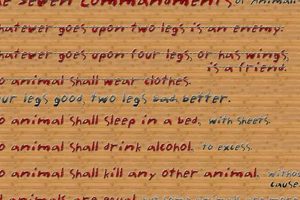
Animalism, the system of thought developed from Old Major’s teachings, is a direct allegory for communism. Both advocate for a classless society, communal ownership, and the elimination of exploitation. The Seven Commandments of Animalism mirror the core principles of communist ideology, promising equality and liberation from oppression. However, the subsequent corruption of Animalism reveals Orwell’s skepticism about the practical implementation of communist ideals.
- The Utopian Ideal and its Downfall
Both Marxism and Animalism propose a utopian vision of a society free from exploitation and inequality. Old Major’s dream of a society where all animals are equal and live in harmony mirrors the communist ideal of a stateless, classless society. However, the eventual descent of Animal Farm into totalitarianism underscores the dangers of utopian thinking and the potential for revolutionary ideals to be perverted by those seeking power.
The allegorical representation of Marx and Lenin through Old Major allows Orwell to dissect the theoretical underpinnings of communism and critique its practical application in the Soviet Union. By portraying the revolution’s initial promise and its subsequent betrayal, Orwell highlights the dangers of ideological dogmatism, unchecked power, and the inherent flaws in utopian social engineering.
2. Animalism's Marxist Roots
The connection between Animalism’s Marxist roots and Old Major’s representation is direct and foundational to understanding Animal Farm as a political allegory. Animalism, the ideology that sparks the animal revolution, is a clear analogue to Marxism. Old Major, the animal whose dream inspires the rebellion, embodies the figures of Karl Marx and, to a lesser extent, Vladimir Lenin. The principles he espousesthe inherent exploitation of the working class (animals) by the ruling class (humans), the call for a classless society, and the collective ownership of resourcesare all central tenets of Marxist thought. Therefore, Animalism’s Marxist roots are not merely incidental but constitute the very essence of Old Major’s symbolic function. Understanding this connection is essential for deciphering Orwell’s broader critique of revolutionary ideology and its potential for corruption.
The importance of Animalism’s Marxist roots extends beyond a simple parallel. It provides the framework for the narrative’s exploration of power dynamics and social control. For instance, the initial egalitarian ideals of Animalism, enshrined in the Seven Commandments, are gradually eroded and rewritten by the pigs, reflecting the distortion of Marxist principles in the Soviet Union under Stalin. The maxim “All animals are equal, but some animals are more equal than others” encapsulates this perversion, demonstrating how revolutionary ideals can be manipulated to justify inequality and oppression. Real-world examples of socialist revolutions, such as the Russian Revolution, provide historical context for understanding the practical significance of Orwell’s critique. They demonstrate the challenges inherent in translating abstract ideological concepts into concrete social realities and the potential for revolutionary movements to devolve into authoritarianism.
In summary, Animalism’s Marxist roots are inextricably linked to Old Major’s allegorical role. He serves as the vessel through which Marxist ideology is introduced and subsequently critiqued within the narrative. The understanding of this connection is not merely an academic exercise, but crucial for comprehending the novel’s warning against the dangers of utopian ideals, unchecked power, and the betrayal of revolutionary principles. The challenges inherent in implementing Marxist principles, as exemplified by the fate of Animal Farm, serve as a cautionary tale applicable to any revolutionary movement or utopian scheme.
3. Revolutionary Idealism
The character of Old Major in Animal Farm embodies revolutionary idealism. His vision of a society free from human oppression is fueled by a fervent belief in the inherent goodness and potential of animals to govern themselves equitably. This idealism, directly analogous to the utopian aspirations of early socialist thinkers, serves as the catalyst for the animal rebellion. Old Major’s speech, filled with promises of liberation and equality, ignites the animals’ hope and inspires them to risk their lives in pursuit of a better future. Without this initial spark of revolutionary idealism, the animals would likely have continued to endure their subjugation, lacking the motivation and collective identity necessary to challenge the established order. The practical significance lies in understanding that revolutionary movements often originate from sincere, albeit sometimes naive, desires for social change, a dynamic historically observed in various uprisings and revolutions worldwide.
However, the narrative arc of Animal Farm demonstrates the inherent dangers associated with unbridled revolutionary idealism. The initial fervor and commitment to the principles of Animalism gradually erode as the pigs, driven by their own ambitions, begin to manipulate and distort the original ideals. The seven commandments, initially designed to ensure equality and prevent exploitation, are subtly altered to justify the pigs’ increasing privileges and control. This corruption highlights the vulnerability of revolutionary movements to internal power struggles and the subversion of their original goals. The French Revolution, with its descent into the Reign of Terror, and the Russian Revolution, culminating in Stalinist totalitarianism, offer historical parallels that underscore the challenges of maintaining revolutionary purity in the face of human fallibility.
In conclusion, Old Major’s representation is inextricably linked to the theme of revolutionary idealism. He embodies the initial hope and promise of a better world, but also foreshadows the potential for that vision to be betrayed and corrupted. The practical significance of this understanding lies in recognizing the complex interplay between idealistic aspirations and the realities of power, highlighting the need for constant vigilance and a critical examination of revolutionary movements to prevent the perversion of their original aims. The character serves as a reminder that while revolutionary idealism can be a powerful force for positive change, it must be tempered with pragmatism and a realistic assessment of human nature.
4. Vision of Utopia
The “vision of utopia” is intrinsically linked to Old Major’s representation in Animal Farm. He articulates the foundational principles upon which the animals’ utopian society is to be built, promising liberation from human oppression and a future characterized by equality and abundance. This vision, analogous to communist ideals of a classless society, serves as the primary motivating factor for the animal rebellion. The importance of the utopian vision is demonstrated by its power to unite disparate groups of animals under a common banner and inspire them to overthrow their human masters. However, the practical consequence of this unwavering faith in an unrealizable ideal is the animals’ susceptibility to manipulation by the pigs, who exploit their utopian aspirations to consolidate power. History provides examples of revolutionary movements, like the early Soviet Union, that began with utopian visions but ultimately devolved into totalitarian regimes, demonstrating the danger of pursuing ideal societies without considering practical realities and human fallibility.
The significance of understanding this connection resides in recognizing the duality of utopian ideals. While they can inspire positive social change by providing a framework for imagining a better future, they also possess the potential to blind adherents to the realities of power and the corrupting influence of authority. Old Major’s vision of a world free from exploitation, though noble in its intent, fails to account for the inherent selfishness and ambition of individuals, particularly the pigs. This lack of foresight allows the pigs to gradually undermine the principles of Animalism, ultimately establishing a totalitarian dictatorship that is far more oppressive than the original human regime. The practical application of this understanding lies in approaching utopian visions with a critical eye, acknowledging their inherent limitations and recognizing the importance of safeguards against the abuse of power.
In summary, Old Major’s representation is inseparable from the vision of utopia he presents. This vision acts as the initial driving force behind the animal rebellion, yet it also sets the stage for the animals’ subsequent exploitation and the failure of their revolution. Understanding this connection highlights the challenges of translating utopian ideals into practical realities and underscores the need for vigilance against those who would manipulate such aspirations for their own gain. The broader theme explores the inherent tension between idealistic visions and the realities of power, serving as a cautionary tale against the uncritical embrace of any ideology, regardless of its initial promise.
5. Critique of Ideology
The relationship between the critique of ideology and the representation of Old Major in Animal Farm is foundational to interpreting the novel’s satirical intent. Old Major’s character serves as a vehicle for exploring the dangers inherent in utopian ideologies and the ease with which such systems can be corrupted. The novel scrutinizes the application of abstract ideals in real-world scenarios, revealing the potential for revolutionary fervor to devolve into oppressive regimes.
- Oversimplification of Complex Problems
Old Major’s ideology, Animalism, simplifies the complexities of social and political organization into a binary opposition: animals good, humans bad. This reductionist approach ignores the nuances of individual behavior and the potential for animals to replicate the oppressive structures they sought to overthrow. This is evident in the pigs’ subsequent manipulation of the other animals, exploiting their naivet and limited understanding of complex issues. Similar oversimplifications can be seen in various real-world ideologies, which often offer simplistic solutions to intricate problems, leading to unintended consequences.
- The Cult of Personality
Although Old Major dies early in the narrative, his ideas and image become a focal point for the animals’ devotion. This creates a cult of personality, allowing the pigs to legitimize their power by invoking Old Major’s name and distorting his teachings to suit their own agendas. The use of propaganda and the rewriting of history further solidify this cult, suppressing dissent and maintaining control. This phenomenon is observable in numerous totalitarian regimes, where leaders are elevated to near-mythical status, and their ideologies are presented as infallible and beyond question.
- The Betrayal of Revolutionary Principles
The pigs’ gradual abandonment of Animalism’s core tenets demonstrates the betrayal of revolutionary principles. The initial ideals of equality and shared resources are replaced by a hierarchical system in which the pigs enjoy privileges and exploit the other animals. This deviation from the original ideology is rationalized through propaganda and the manipulation of language, effectively masking the pigs’ self-serving actions. This pattern is often replicated in revolutionary movements, where power struggles and corruption lead to the abandonment of the initial goals, resulting in a system that is often more oppressive than the one it replaced.
- The Dangers of Uncritical Acceptance
The animals’ unquestioning faith in Animalism and their susceptibility to the pigs’ propaganda highlight the dangers of uncritical acceptance of ideology. Their lack of critical thinking skills and their inability to recognize the contradictions between the pigs’ actions and the stated principles of Animalism allow the pigs to maintain their control. This underscores the importance of independent thought and critical analysis in preventing the manipulation of individuals by those in positions of power. A populace that is unable to question authority or critically evaluate information is vulnerable to ideological indoctrination and the erosion of its freedoms.
In conclusion, Old Major’s representation within Animal Farm serves as a potent critique of ideology, exposing the potential for utopian visions to be distorted and manipulated for self-serving purposes. The novel’s satirical portrayal of the animals’ revolution underscores the importance of critical thinking, vigilance against the abuse of power, and a realistic understanding of human nature in preventing the perversion of noble ideals into oppressive systems. By illustrating the dangers inherent in uncritical acceptance of any ideology, the novel offers a timeless warning against the seductive allure of simplistic solutions and the potential for revolutionary fervor to be exploited by those seeking to consolidate power.
Frequently Asked Questions
This section addresses common inquiries regarding the symbolic representation of Old Major in George Orwell’s Animal Farm, providing clear and informative answers to enhance understanding of the novel’s allegorical structure.
Question 1: Does Old Major exclusively represent Karl Marx?
While Old Major primarily embodies Karl Marx, particularly concerning the development of Animalism (an allegory for Marxism), elements of Vladimir Lenin are also present, notably in the call for and inspiration of revolution. Therefore, the representation is not entirely confined to Marx alone.
Question 2: What aspects of Marxism are reflected in Animalism?
Animalism mirrors core Marxist concepts such as the exploitation of the working class by the ruling class, the call for a classless society, communal ownership of resources, and the abolition of private property. These parallels are central to understanding the satirical nature of the novel.
Question 3: Why is understanding Old Major’s allegorical significance important?
Understanding Old Major’s representation is crucial for comprehending the novel’s critique of totalitarianism and the potential for revolutionary ideals to be corrupted. It illuminates the initial promises of the revolution and the subsequent betrayal of those promises by the pigs.
Question 4: How does “Beasts of England” relate to Old Major’s representation?
“Beasts of England” functions as a revolutionary anthem, similar to the Internationale in socialist movements. It embodies the unifying power of ideology and Old Major’s dream, galvanizing the animals to rebel against human oppression. Its subsequent banning symbolizes the suppression of revolutionary ideals.
Question 5: Is Animal Farm a direct attack on Marxism?
Animal Farm is not necessarily a direct attack on Marxism as a philosophical concept. Instead, it serves as a critique of the implementation of Marxist ideals, particularly in the context of the Soviet Union under Stalin. The novel highlights the dangers of unchecked power and the distortion of revolutionary principles.
Question 6: What are the long-term implications of Old Major’s teachings on Animal Farm?
The long-term implications are the complete subversion of Old Major’s initial vision. The pigs, under Napoleon’s leadership, establish a totalitarian regime that is far more oppressive than the previous human rule. This demonstrates the cyclical nature of power and the potential for revolutions to betray their original aims.
In summary, Old Major’s character is a complex allegorical representation of both Marxist ideology and the figures who sought to implement it. Analyzing his role is paramount for understanding the novel’s themes of power, corruption, and the betrayal of revolutionary ideals.
The following section will explore the ways this initial spark of revolutionary idea is used and abused in the Animal Farm novel.
In Animal Farm Who Does Old Major Represent
This exploration has established that the character in George Orwell’s Animal Farm functions as an allegorical representation of Karl Marx and, to a lesser extent, Vladimir Lenin. His enunciation of Animalism mirrors Marxist ideology, critiquing the exploitation of the working class and advocating for a classless society. The analysis reveals the character’s pivotal role in initiating the animal revolution, setting the stage for the novel’s broader examination of power, corruption, and the subversion of revolutionary ideals.
The enduring significance of this allegorical representation lies in its cautionary message regarding the implementation of utopian ideologies. The degradation of Animal Farm serves as a testament to the potential for revolutionary movements to betray their founding principles, demanding continual critical reflection on the nature of power and the responsibility of individuals to safeguard against its abuse.